Wednesday, December 08, 2010

30 anniversary of John Lennon's death

Note: Mentioned today on my Tom Brady piece for The Hill. "For the past 15 years I’ve watched the headlines on Dec. 7 and 8 as a barometer of the times. Pearl Harbor was Dec. 7, and on Dec. 8 John Lennon was murdered in NYC. Each year Pearl Harbor wins. This year there was barely a mention of Pearl Harbor and John Lennon is on front pages everywhere. There are three op-eds about Lennon today in the NY Times. It is a seismic shift in my opinion, marking the beginning of the century, the millennium. Lennon will be remembered in time as the most important English person to date since Victoria. For more on John Lennon Google “Quigley in Exile”. But after the football game Monday night Tom Brady is more on my mind." Here is the John Lennon piece:

On the 25th Anniversary of His Death

"Is it not written in your law . . . you are gods?" John 10:34

"The crosses are all full," said the lay brother.
"Then we must make another cross. If we do not make an end of him another will, for who can eat and sleep in peace while men like him are going about the world?" -
"The Crucifixion of the Outcast," Celtic tale retold by William Butler Yeats in Mythologies

"Zen demands intelligence and will-power, as do all the greater things which desire to become real." These are the words of C. G. Jung in the introduction to D.T. Suzuki’s An Introduction to Zen Buddhism. Jung’s words and observations would win him a place top row center, right next to Edgar Allen Poe, on the cover of Sgt. Peppers. In the 1950s Suzuki was always referred to as Dr. Suzuki – much as Richard Gere is referred to as only Richard today by Tibetan Buddhists. It is kind of an honorarium, a title. Dr. Suzuki was a solid forefather on the path East and one of the very first learned Masters to come from the East to the West.
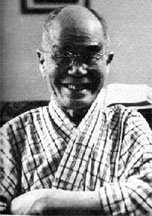
In the 1950s he taught at Columbia University and was a celebrity in New York City, an exotic but common monk with a great smile and a pure vision of Zen. Personal experience is everything in Zen, said Dr. Suzuki. No ideas are intelligible to those who have no backing in experience. Mystification is far from being the object of Zen itself, but to those who have not touched the central fact of life Zen inevitable appears as mystifying. Penetrate through the conceptual superstructure and what is imagined to be a mystification will at once disappear, and at the same time there will be an enlightenment known as satori.

Dr. Suzuki talked straight: personal experience is everything in Zen. The purpose of life is love. I’m not sure if John Lennon read these words but perhaps his wife, Yoko Ono, did. She was a key figure in the avant garde art scene in New York City at the time and had been in New York for a long time, even as a student at Sarah Lawrence. She was well known as a conceptual artist before she met John Lennon, and lived and worked in the same realm as people like John Cage and Marcel Duchamp. These would be the first people in New York to listen to Dr. Suzuki.

The art students were always the first to catch on, and John Lennon and his friend Stu Sutcliffe were the art students who started The Beatles. They were like pilot fish for the rest of us who were born at the end of the war and it was quite a large school of fish. 40 million people. All our fathers had been warriors. We were all the same age and born within months of one another, conceived by men who had been a long time without women, directly on return from war in Asia and Europe.

For us it was a bristling, exciting respite between childhood and adulthood and we were interested in new things. There were no teachers around to deflect our learning, no priests to lead us astray. For the briefest period, all of the shields were down. Other voices would come shortly. Swami Yogananda, who wrote The Autobiography of a Yogi, would become very popular for awhile. John said he read about half of it, which I thought was pretty good, as I’d only managed about 80 pages. Later, the Maharishi Mahesh Yogi and Tolstoy. But Suzuki’s message entered the river of our generation at the same time as John entered our river. At first much of the Zen around New York was dark, misunderstood in the West as nihilism, the shadow which withered the Western heart after 500 years of exploration and dominance. But John and Stu understood Dr. Suzuki’s Zen message that love is the purpose of life.

John is said to have started The Beatles to have something to do with Stu. When McCartney entered the group he drove them to become more serious and businesslike. But at first it was always John and Stu. Stu had the artist’s eye for style – naming the group The Beatles after seeing Lee Marvin and Marlon Brando in The Wild Ones. Lee Marvin’s motorcycle gang was called The Beetles. Stu always attracted the coolest people as well. And when they went to Berlin before the group was fully formed he attracted the beautiful photographer Astrid Kirchherr, who would become an anima figure – a muse – to the group and open them up in the mind in new ways and awaken new music and images.

An avante garde photographer in Germany, she and her friends, including Klaus Voorman, traveled in the seedy night scene in Berlin and met the group there, which was still going under the name of The Silver Beatles. She gave them the playful Beatles haircuts. Friendship would bind them. Stu married Astrid and Klaus later drew the cover picture for the Revolver album, and much later, after The Beatles had broken up, he played as a background musician on the Imagine album.

Personal experience would guide the fledgling poet as well, and like many ordinary men before him, Lennon became great when someone he loved died. He would remember them all. And he would remember Stu, who never returned to England with them.

I know I’ll always feel affection, for people and things that went before. I know I’ll always think about them.

But it was different with Stu.

In my life, I loved you more.

This requiem, this love song, is considered today to be one of the greatest songs ever written. It is the beginning of the artist’s journey for John Lennon.
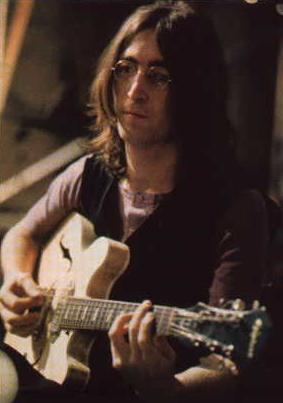
The Sixties was a cacophony of a million sounds and smells and voices and music and colors and textures, but especially music. The electric guitar was like a key; an ancient iron ornamented key to a mediaeval dream door that would open to an age.

Every age, be it short or long, has a beginning, a middle and an end, like a person’s life, and this age was no exception. This age, someone pointed out, came with its own sound track. And it rose and fell rather quickly.

At the center was The Beatles and the Sixties rose and fell with the fate of the Beatles. And at dead center, the man in the center of the Beatles was John Lennon.

From beginning to end The Beatles was about John Lennon. He was not the most important innovator or instigator of the period, except perhaps in music, but the music would eventually become secondary to his life, as literature had become secondary to Tolstoy.

He was one of us, common and working class, but of course, more gifted. And the transformation he made, we made. Eventually he left The Beatles behind to complete the passage himself. He was the Man at the Center who made passage with us and for us and completed the journey on our behalf. And I don’t think we could have or would have completed passage without him.

The remaining Beatles say they were transformed by Bob Dylan like the rest of us were. John was as well. It shows in his pictures. It shows in his clothes and in music like Norwegian Wood, a folksy, spare song inspired by the folk scene, written when the Beatles would begin to rise to a higher artistic level. John, they say, wanted to conquer the world, which The Beatles did with ease. Then, when they heard Bob Dylan, they aspired to be artists.

Dylan opened the gate and performed the Rite of Entry to the age with his soulful cohort Joan Baez, and the age rose to the center when The Beatles reached their artistic apex. Then followed the rite of exit with Joni Mitchell and the howling animal cries of Neil Young, mourning the passing of the brief and sacred moment.

The Beatles, at the top of their creative arc -- that would be somewhere within the Sgt. Peppers area -- brought the defining moment to a generation. Some 30 years later, in January, 2001, New York Times columnist Maureen Dowd contrasted the generation with George Bush, Jr., who last week threatened to cast the first veto of this presidency to overthrow Congress’s attempt to ban his policy of allowing the torture of military prisoners.

In his first month in office she wrote, “He said he never liked the Beatles after they got into that ‘kind of a weird psychedelic period.’” One either crossed the river or did not, and those who did not, struggled to create a counter-force. (Ten weeks into his presidency Dowd reported going hungry for a shred of modernity. “Bush II has reeled backward so fast, economically, environmentally, globally, culturally, it’s redolent of Dorothy clicking her way from the shimmering spires of Oz to a depressed black-and-white Kansas,” she lamented. “What’s next? Asbestos, DDT, bomb shelters, filterless cigarettes? Patti Page?”)

Not unlike George Bush, John Lennon was preoccupied with Jesus. You could see it early on with the trouble he got into when the Beatles were first big. Fans would crowd them and overwhelm them and once John said to a crowd of reporters, “We’re more popular than Jesus.” There was no arrogance to it, but subtle awareness. The Beatles were more popular than Jesus. Yet Bush and Lennon couldn’t be more far apart in their quests.

In The Tao of Jung, psychiatrist and Jung scholar David H. Rosen discusses C.G. Jung’s decent into the shadowy world of the collective unconscious, the world beyond the conscious ego. On the way into the “cave” of the unconscious stood a dwarf with a leathery skin, as if he were mummified, which Jung squeezed past. Rosen explains this in terms of Indian mythology: “Shiva steps on a dwarf that represents the ego when this deity does its creative dance of death and rebirth.”

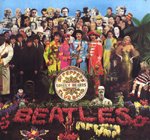
Likewise with the Beatles. When they began their real creative work, they left behind the casings of their early ego identity, pictured as four mop-top wax dummies in early Beatles suits at what appears to be a burial on the cover of the Sgt. Peppers album, while the “new” Beatles appeared above like butterflies just left the cocoon in brightly colored satins and playful epaulets.
At the building vortex of their work, John went through a classic shaman’s arc, the same as the one described by Dante in The Divine Comedy; the same ascribed to Jesus by his followers thus, “. . .he descended into hell the third day . . . . he ascended into heaven.” (As E.C. Krupp writes that Santa Claus, an archaic remnant of a Norse shaman, enters the subtle realms of the archetypal shamanic journey by descending the chimney to the Underworld and flying through the Cosmic Heavens with magical reindeer.)

This is the classic pattern of the journey of the shaman described by anthropologists and it occurred with John as the Beatles rose to the top of their creative arc. IN this kind of psychological transformation, the man or woman who is about to enter into Unconscious falls, out of nowhere and against his or her will, into a funk. He falls into a torpor, a sickness of the mind and heart and feels a worthlessness to his life. He goes through a period of spiritual death and descends deep into the earth. Afterwards, he ascends and rises into heaven. Finally he emerges transfigured and enlightened god king, leaves the celestial place and comes out, usually down from a mountain, with a simple transforming idea for the tribe, a gift from the Land of the Dead.

Lennon went through such a transformation, falling into a psychological funk and getting fat and afraid at the peak of the Beatles initial popularity (“Help,” he sang. “I’m a loser, and I’m not what I appear to be.”) Then at the Revolver album, something new began to happen. Suddenly there is a sense of entering the river, an image which occurs in dreams at times of birth or death (“turn off your mind, relax and float downstream,”) and at times of psychological transformation. In Buddhism and Taoism, it is the sign of a new awakening.
He sang a second song on the same album about floating downstream in a transcendent, blissful sleep, while everyone thinks he is just lazy, (but “I don’t mind,” he sings, “I think they’re crazy”). Some say I’m Only Sleeping is aesthetically the best song he ever composed.

In terms of anthropology, this is the first orientation of an earth shaman finding his feet in the Underworld – the creative unconscious – the world under the earth, where he will take you down with him into the density of the earth, but this is the Subtle Realm of the earth, the Underworld, where “nothing is real” in Strawberry Fields.

And there he finds clarity and confidence, but in a new world, the world of the Unconscious where there is understanding of all you see with eyes closed, and the old world becomes a shell, a mere caricature of psychic life.

The shaman then ascends out of the earth and into the sky, like Jesus rising out of the tomb and entering heaven. John and the Beatles rise then to the very height of their work in Sgt. Peppers Lonely Hearts Club Band. And here at their best work is the shaman’s archetypal journey to the heavens in Lucy in the Sky with Diamonds. Like the Underworld of Strawberry Fields, the Astral Heavens also have otherworldly features, like newspaper taxies and magical rivers with tangerine trees and marmalade skies (like the tree “showered with reddish blossoms” blazed in light, a cosmic vision Jung had – a “vision of unearthly beauty” which oddly enough, took place in Liverpool, home of the Fab Four. Lennon’s dream vision in Lucy in the Sky with Diamonds also echo’s Dante’s, looking upon the stars from above, in Paradise: “I saw light in the shape of a river/Flashing golden between two banks/Tinted in colors of marvelous spring./Out of the stream came living sparks/Which settled on the flowers on every side/Like rubies ringed with gold . . .”).
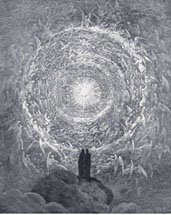
At the peak, John wrote a song called I am the Walrus in which he invoked the Upanishads, which along with The Autobiography of a Yogi was very popular back in those days. John wrote, “I am he,” about the swimming together of all of us at the peak of the Sixties, and “we are all together.” “I am the Eggman,” he sang, with his characteristic Liverpool humor, “. . . they are the Eggmen. I am the Walrus.”

Lennon’s favorite book was Alice in Wonderland and the Abbey Road album contained a snippet of Lewis Carroll's prose. He may have drawn on Lewis Carroll’s wise Walrus, who would fit right in on Sgt. Peppers, holding forth on cabbages and kings to a horde of oysters.

It is all comic and hidden, but it reflects an awareness he had about being a man at the center of a world in transformation. The words, “I am he,” are from the core of Eastern spirituality and are well known to its practitioners. Shimon Malin’s recent book Nature Loves to Hide: Quantum Physics and Reality, a Western Perspective offers an explanation from science: He writes, “Erwin Schrödinger had the experience of finding the soul of the universe within himself, as his own ultimate identity. He expressed his finding as follows: Inconceivable as it seems to ordinary reason, you – and all other conscious beings as such – are all in all. Hence this life of yours which you are living is not merely a piece of the entire existence, but is, in a certain sense, the whole; only this whole is not so constituted that it can be surveyed in one single glance. This, as we know, is what the Brahmins express in the sacred, mystic formula which is yet really so simple and so clear: Tat twam asi, this is you [or I am he or this is that]. Or, again, in such words as ‘I am in the east and in the west, I am above and below, I am this whole world’.”
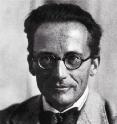
Malin writes that Wolfgang Pauli, when asked if he believed in a personal God, responded with an answer that suggests a mandala: “May I rephrase your question? I myself should prefer the following formulation: Can you, or anyone else, reach the central order of things or events, whose existence seems beyond doubt, as directly as you can reach the soul of another human being? I am using the term “soul” quite deliberately so as not to be misunderstood. If you put your question like that, I would say yes.”

This expression reflects the sentiment of the Upanishads in which the Atman (the Eggman) or the individual soul, finds itself at one with another individual soul, then another, then the whole soul, the world soul, the God consciousness, the Brahmin (the Walrus). It is what Jesus had become after he had gone through the Transfiguration, referring to himself as at one with the God force, at One with the Father. This is the Brahma consciousness.
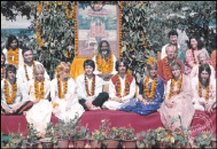
The Beatles were at their peak with Sergeant Peppers. There John would find fulfillment, anthropologically speaking. Then he would journey to the East, although Paul and Ringo were bored, and find the mystic Maharishi Mahesh Yogi, a father figure to him, but a Great Father, a spiritual father, not an earthly father.

The shaman’s work is essentially over by then, except to bring the gift idea to the community. The shaman has brought the tribe with him through the transformation of the Unconscious. It is up to us after that.

Yet some of the Beatles greatest work would come as they traveled down the back side of the mountain. The White Album is still a favorite to fans. One song, I’m So Tired, wonderfully reflects the rite of exit of the exhausted artist that comes at the end of the transformational passage, balancing the liberating I’m Only Sleeping, at the rite of entry.

It is characteristic of the dark side of the passage that the archetypes reverse themselves and show themselves not as they are in the holistic form of the inner life, but just the opposite, shattered in the outside world, reflecting that the center has been passed through and we have once again entered the flat consciousness of the everyday world. And in this instance, it was a hostile world at war in Vietnam and on the streets and campuses of the United States (“Happiness is a warm gun,” sang John)

“Can one live with a shattered glass?” the guru classically asks a Tibetan monk who has just found Enlightenment.

And here – classically - the Beatles reject their psychological god-king, the Maharishi, and even publicly denounce him. Here John sings, “My mother is of the sky.” Lucy is of the sky, his anima, his female counterpart whom he found in transcendent journey. Mother is of the earth. And the tricksters continue their playful treachery, fooling their audience and keeping them off guard with pranks like this one: “ . . . here’s another clue for you all. The Walrus was Paul.”

The Walrus, of course, was John.

Coming off the backside of the mountain – and on return form India - John sometimes believed he was carrying – channeling, we say – Jesus and said so to the Beatles. And he made occasional references, even paraphrasing the Gospel of Thomas “. . . the inside is out/the outside is in. . .” on the White Album.
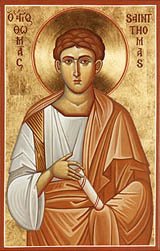
The full text is, “Jesus said to them:/When you make the two one,/and make the inside like the outside,/and the outside like the inside,/and the upper side like the under side,/and (in such a way) that you make the man/(with) the woman a single one,/in order that the man is not man and the/woman is not woman; when you make eyes in place of an eye,/and a hand in place of a hand,/and a foot in place of a foot,/an image in place of an image;/then you will go into [the kingdom].” – from The Gospel of Thomas.

This preoccupation with Jesus appears again and again. “Christ, you know it ain’t easy,” he sang in one of his last songs, suggesting in The Ballad of John and Yoko that he, like Jesus, would be crucified.

Certainly Lennon made himself look like Jesus at the end of the Beatles. On their last album cover, Abbey Road, he is dressed all in white, like Jesus after the Transfiguration, with the Beatles trailing him across the road, like the Three Celestial Ones (see this blog in January, 2006 for the Three Celestial Ones), following in his wake. (And cultism would abound in the Beatle myth. The old Catholic myth about the three secrets revealed to the children at Fatima by the Blessed Mother took a pernicious turn into hippie lore in the late 1990s when the Pope revealed the third secret to be about a “man in white” who would be gunned down when he returned from the mountain top. The Pope, who had been wounded in an attack at the same time that Lennon was murdered, revealed the contents of the letter to the public because he said the prophecy had been fulfilled. John Paul II, who wore white garments at public ceremonies, claimed to be the man identified in the prophecy.)

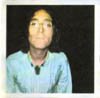
Even later, at the very end of his life Jesus is suggested. All through the most creative period, the shaman’s journey from Sgt. Peppers to the end of Abbey Road, John wore a special flowered talisman around his neck. Afterwards, he stopped wearing it. But in New York, in one of the later pictures ever taken of him, a well-known photograph where he is wearing a t-shirt that says New York City across the front, there is a tiny cross hanging from his neck.

At the end of the Beatles period John continued in a prophet’s journey. Like Moses and the Bodhisattva, he returns from a celestial vision on top of the mountain with a simple transforming idea, as Moses did with the tablets.

It is the same idea that has occurred throughout the century but is new to our century here in the West. It is Emerson’s message and here it is again expressed ten years before the Beatles by C.G. Jung: “Our world has shrunk, and it is dawning on us that humanity is one, with one psyche. Humanity is a not inconsiderable virtue which should prompt Christians, for the sake of charity – the greatest of all virtues – to set a good example and acknowledge that though there is only one truth it speaks in many tongues, and that if we still cannot see this it is simply due to lack of understanding. No one is so godlike that he alone knows the true word.” As Woodstock guru Satchidananda put it, “One truth, many paths.”

It is the same idea that Leo Tolstoy, a Great Father figure to the non-violence movement of the Sixties, had brought to the world after his night of the dark soul when he went through a religious transformation.
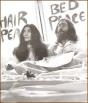
Lennon, with his wife Yoko Ono, entered the peace movement when he left the Beatles, and like Tolstoy later in life, attempted to apply his natural gifts didactically to public purpose. He is said to have been reading Tolstoy’s late non-fiction work on religion and non-violence as many were in the late 1960s, and his final word, the simple transforming idea he brought down from the mountain is precisely the same thought as Tolstoy’s: Imagine there’s no country, it isn’t hard to do. . . Imagine all the people living life in peace.

Tolstoy claimed that there was one singular thought in Christ’s work and that was do not return violence with violence. On this he built the doctrine that would inspire Ghandi and Martin Luther King, Jr. and the anti-war activists of the 1960s. Furthermore, in Patriotism and Government, Tolstoy wrote that patriotism was a practicable solution for nations early in their development, but it was time now to abandon national prejudices. Even Ghandi, who he corresponded with and who admired Tolstoy enormously, had failed in this, he said. The non-violent approach was the right approach, but, said Tolstoy, declaring the nation to be Hindu, “ruins everything.”

It was time for the removal of all barriers. No country, and no religion, too. This would be Lennon’s final impression on the people: Imagine there’s no heaven, it’s easy if you can, no hell below us, a brotherhood of man.

This is precisely Tolstoy’s religious conviction at the end of his life. He advocated abandoning identity with a particular prophet as one would abandon nationalism.

In one of his last writings on the subject Tolstoy clearly states his opinion: “Attributing a prophetic mission peculiar to certain beings such as Moses, Christ, Krishna, Buddha, Muhammad, Baha’u’llah as well as several others is one of the major causes of division and hatred between men.”

John’s swan song, Imagine, reflects timeless Buddhist sentiment like that presented in What the Buddha Taught by Walpola Rahula, which had gained popularity in the Sixties. And is likely an intentional reconstruction of Tolstoyan philosophy which was deeply influenced by Buddhism and Taoism. Intended or not, it completes the shaman’s journey and begins the transformation of the group.

Imagine also bears a relationship to The Gospel of Thomas. Elaine Pagel's book Beyond Belief: The Secret Gospel of Thomas, states that in Thomas’s account, Jesus challenges those who mistake the kingdom of God for an otherworldly place or a future event: Jesus said, “If those who lead you say to you, Look, the kingdom is in the sky,’ then the birds of the sky will get there before you . . .” In a word, Imagine there’s no heaven.

William Butler Yeats writes: “What portion in the world can the artist have/Who has awakened from the common dream/But dissipation and despair?” Such was the lot of John Lennon.

Late in life, broken and in pain, he wrote, “I was the Walrus, but now I’m John.”

One of his biographers writes that he was never happy again after the Sgt. Peppers period. The pictures show it. He never smiled again for the camera after he returned from India.

Tuesday, December 07, 2010


Imagine there’s no football. Maybe California needs Tom Brady

by Bernie Quigley

for The Hill on 12/08/10

If there is a lock out next year America will be left without its basic matrix; that which holds us together and apart in harmony in tension. Hard to think what we in the frozen north will do without Tom Brady and our Dear Leader, Bill Belichick. But since they are just going to be waiting around and not doing anything anyway, I’ve got a few suggestions: Much as we would hate to see him go, Brady should spend the year without football in his home state where he is building a really big house, and plan his next career, starting with governor of California. A few years ago on a national TV interview when he first flabbergasted the football world with those quiet eyes and that steadfast arm, he said he hoped to do more with his life that just “throw a football around.” He said he was thinking of going into politics. I’m sure Mitt Romney, who borrowed his logo for his 2008 run from the Patriots, would help. He lives out there now. And Brady’s broheim, Arnold Schwarzenegger, who lives next door.

Belichick can help out here with his old bud Doug “drop kick” Flutie, who campaigned for Scott Brown, in putting New England back together. Much to be done to tailor health insurance to the region as Governor Romney intended it.

A thought came to mind in those so many times when so many of our national and local polls including Obama and Biden and Bill Clinton and George W. Bush seemed to need help. They seemed to need a life coach and a professional mentor. The thought would occur, What would Tony Dungy do? I mean look what he did for Michael Vick. Imagine what he could do for Joe Biden.

Then listening to David Eisenhower talk about his new book, “Going Home to Glory” and recalling the clarity, good faith, integrity and order which virtually won the war, saved the world and reunited it on a new center, began wondered what it was exactly Dwight D. Eisenhower did to make him get like that? What did he do before the war?

The answer: Football coach. And he was a star halfback at West Point until he injured his knee.

Belichick is old school New England Taoist – listen to this, repeated by Brady after the game on Monday night: “We really take after our coach and he says, ‘When you win, say little. When you lose, say less.’” Sounds like the Tao te Ching, number 82. And these guys are playing football?

Belichick is one of us old school men-don’t-hug New Englanders. But Brady, much as I wish he would be ours always, is California’s and he is California’s finest. CA is new, we are old. Brady is new. And the political arena today is filled with brand new ideas, some great, some terrible. And as in every possible case of new ideas, they need new people. And those who champion great ideas bring them to life and are ever remembered as avatars of the new thinking. ‘Twas ever thus.

Saturday, December 04, 2010


America is now an East/West country (Rick Perry/Carly Fiorina ’12)

By Bernie Quigley

For The Hill on 12/4/10

New York came to prominence with the signing at Appomattox in 1865. But that all changed when John Ford and John Wayne reawakened the western spirit and Ronald Reagan brought the western idea to Washington. With the nomination of Sarah Palin, the call of the wild again ignited in the west and America entered a paradigm shift. Before that moment America could still hope to be a North/South country under New York dominance. From that moment forward, America would be an East/West country.

Since WW II economy and population have shifted from the northeast to the south and the southwest. The Reagan Presidency began to bring the south and west to cultural relevance and political dominance. Rural farm counties like Tobaccoville, NC, saw their voter registration change from Democrat to Republican by 80%; the first time people there would vote Republican. They were not suddenly allying themselves with Wall Street and its Kennebunkport friends, awkward and unconvincing in cowboy boots, who had followed the conquest to Texas. They were allying themselves with Ronald Reagan’s Santa Ynez Mountains and Barry Goldwater’s Arizona. In 1984, 49 of 50 states voted Reagan.

The agricultural and commodities rich middle states were advancing in this period and the blue state/red state division reemerged but with a difference: In the 1830s, the blue industrial northeast was rich and the rural red was dirt poor. Now the blue are poor and calling on the red for support. The other important difference is that the blue northeastern states and CA see themselves as extensions of Europe. The red states do not. They are indigenous American rural cultures: When they look across the Atlantic they see only Israel. In a word, the abstract political temperaments of liberal and conservative America have materialized into oppositional regional cultures.

The red states have awakened and what might be called the Jeffersonian paradigm of colonial days has now risen north from Texas up through the Rockies and heading almost unbroken through to Alaska. As Jefferson challenged Alexander Hamilton’s vision of dominance by New York in the early 1800s, so Sarah Palin and Joe Miller of Alaska do today. So does Texas Governor Rick Perry. (Rick Perry/Carly Fiorina ’12?)

I wrote here on Pundit’s Blog on 8/29/08 hours after McCain picked Palin for VP:

“This is no longer a race between one candidate who brings to mind John F. Kennedy [Obama] and another following in Bush’s Wall St.-with-cowboy-boots theme . . . It [Palin’s entry into the race] opens an entirely new political dialog in the country pitting the Eastern establishment and all of the institutional thinking and baggage that entails against the new mores of the West and the rising spirit of adventure on a frontier still free and open, independent and self reliant.”

The eastern conservative establishment will claim the Reagan mantle hoping to bring control back to New York and Washington. Fred Barnes of the Weekly Standard sees NJ Governor Chris Christie as a hedge against the rising western tide in 2012, somewhat predictably, with Jeb Bush, former governor of Florida, as VP.

But ignoring the natural contours of history can bring conflict and even in time, warfare. History must follow the demographics. The west – Eisenhower, Nixon, Reagan, Palin (Perry, Fiorina) - is rising. The east – Roosevelt, Kennedy, (Bush), Obama - retreating. The demographics have been moving America steady to this position since war’s end.

The great and definitive president is just ahead. Whoever it is will fulfill Reagan’s vision of western awakening and destiny and will set the stage for the new century.

Friday, December 03, 2010


Will Israel survive contemporary Christianity?

By Bernie Quigley

For The Hill on 12/3/10

I would hope that any Jewish studies course at university today might start with a viewing of the very great movie, “The Train,” with Burt Lancaster, about the heroic peasants of the French resistance offering up their lives to save the precious art of the Paris museums, a legacy from Rembrandt to Picasso, from falling into the hands of the Nazis. Lancaster hijacks a train and tricks the Germans to deliver the art unscathed to Free France. It should be immediately followed up by another movie, Alain Resnais’ “Night and Fog,” a gritty documentary about the deportation of Jews on trains to Hitler’s death camps. Because the question cannot arise from watching them save the precious art of Paris why they didn’t do the same for France’s Jews.

Art had become France’s religion. Possibly why it was so easy to conquer. But the two films together illustrate an elementary impulse about the cloak of cowardice that rewards substitute action for the true work that needs to be done: Substitutes saving pictures for saving Jewish lives.

The French have thought a great deal about this and Marcel Ophuls’ “The Sorrow and the Pity” examines French cowardice and collaboration. Possibly not enough. When I worked in New York City in the later 1970s I was perhaps the only non-Jewish Bernie to eat breakfast at DuBrow’s Cafeteria in the garment district. The rest were old Jewish men. Everyone had a relative killed in Hitler’s camps. And so did all Jewish friends my age.

It was the Age of Golem, the rough beast which would sweep across Europe since Rabbi Loeb unwittingly released it in Prague in the 16th century. Golem is still with us and this time hides behind a cloak of religious respectability.

As Marvin Hier and Abraham Cooper report in a WSJ op-ed, “Presbyterians Against Israel” today, “ the anti-Israel politics of certain powerful Christian bodies hampers interfaith relations and threatens to breathe new life into medieval doctrine that demonized Jews for hundreds of years.”

In 2007, they report, the World Council of Churches, an umbrella organization of mostly liberal Protestants claiming a membership of 580 million worshippers, convened the "Churches Together for Peace and Justice in the Middle East Conference." The conference produced the Amman Call, a document that condemned violence and endorsed a two-state solution to the Israeli-Palestinian conflict, but denied Israel's right to a future as a Jewish state.

Again, in 2008, they say, the World Council of Churches convened a group of Protestant and Catholic theologians to review the underpinnings of Christian attitudes toward Israel. (No Jews were invited.) The group published the so-called Bern Perspective, which, among other things, instructed Christians to understand all biblical references to Israel only metaphorically.

It marks a return to "replacement theology," they say, “the medieval view that the Church has replaced Israel in God's plan and that all biblical references to Israel refer to the "new Israel"—that is, to Christians.”

Jewish friends my age have largely gone over to Bill Clinton and Mick Jagger (did somebody say golem?). In America, Israel’s only true and reliable friends today are earthy red necks (Johnny Cash, grits, Mammoth Jack mules and Pastor Hagee) of the old rugged cross persuasion. But they seem a worthy crew compared with the art lovers and appeasers of Vichy France and the current World Council of Churches.

Thursday, December 02, 2010

Palin/Romney ’12 or Perry/Christie ’12?

As commentator Armstrong Williams says, Sarah Palin has finally gotten the attention of the media, now they won’t let go. That is the way in mass media. It could be a problem for democracy, maybe causing the neurosis Prof. Paul Eidelberg calls “demophrenia” but that’s the way it is right now. Already, op-eds have appeared in the New York Times calling for “our own Sarah Palin,” and the Washington Post calling up “the next Sarah Palin.”

She has made her mark, and so has Fox News. In Ted Koppel recent essay criticizing MSNBC and Fox for demagoguery (Olbermann, O’Reilly and the death of real news,” 11/14/10), he matched the left’s Keith Olbermann, Rachel Maddow and Chris Matthews on MSNBC with Glenn Beck, Sean Hannity and Bill O’Reilly from Fox. But a telling trend of the times is that the MSNBC group is expected to lose their jobs when the network is sold. While the Fox crowd is a rising point of departure. Fox Business, which grew from Fox News, today features the respectable and entertaining Neil Cavuto, Charlie Gasparino and the inimitable libertarian, Judge Andrew Napolitiano, urging listeners to “Stay free!” This same crowd appears occasionally on Fox’s Don Imus morning show. Pretty mainstream. The zeitgeist has shifted to the right.

Mitt Romney sees it. His experience in South Carolina with Nikki Haley was telling. He was the first national figure to come to her aid when local (Republican) thugs tried to slander her. He did the right thing when it needed to be done. But it didn’t make much of a bump in Haley’s approval rating. A week later Palin endorsed Haley and her ratings skyrocketed. She won the governorship.

That should tell Romney how well he would do in the South Carolina primary. And it is already a lesson he learned earlier in Iowa, where he spent 20-some million and Mike Huckabee won. Palin is very popular in Iowa and could very well beat Huckabee this time. Radio commentator Lee Davis says if Palin wins Iowa and South Carolina and Romney wins New Hampshire, she will have the nomination. Could be.

Sarah Palin wants to do the right thing and so does Texas governor Rick Perry. Both have said that they would only think of running if no one else was running who would address the same issues they talk about, which is to say, Tea Party issues. I think they were talking about each other. Perry is an enormously attractive candidate but Palin has already managed to commandeer the media zeitgeist. Romney might sense now that his only road to the Presidency is following Palin as her VP. If he followed Palin he could package the feral spirit of Alaska and the west as no other could. And packaging is what it needs. But it would take Perry a little longer to get his own formidable kung fu going.

All interested should first look up New Jersey Governor Chris Christie’s recent speech at the Foundation for Excellence in Education, where he told the crowd, “This is our moment.” Because Christie can make you cry. Not in a sad or unhappy way, but the way the crowd cried in the movie “Casablanca” when Victor Laszlo ordered the band to play La Marseillaise.

Wednesday, December 01, 2010


Waiting

By Bernie Quigley

For The Hill on 12/1/10

OMG! news reports that James Franco and Anne Hathaway will host “Hollywood’s biggest night,” the Oscars. Omg! He played the sidekick in “Spiderman,” I think, and she was in that movie which gave away the ending to “Lost.” Suggests we are in a between; a time waiting as Israel waits for David, as Marcos Moulitsas and crew from the Daily Kos waits for the Clinton era people to go away, - the time described by the Wu Priesthood as “wu chi”; undifferentiated karma between worlds; imagine there’s no heaven, no country, no religion too. Imagine there’s no Oprah. Imagine Dr. House finally gets a girl friend. Imagine the new generation finally arising, but for big screen Hollywood, there won’t be one.

The art has moved on, and so have the artists. There is still occasionally mastery in the combined big-screen story-telling of Jeremy Renner and director Kathryn Bigelow like that in “Hurt Locker,” and flashes of light in the work of director Catherine Hardwicke. But a glimpse at the Redbox window will tell you what Blockbuster has recently discovered: That which started in John Ford’s Arizona desert has been taken down by the tumbleweed.

Today, artists work in TV. For a long time now, TV has been hiding its mastery, riding beneath the censors as the great Russian writers did in the 19th century: In “Mad Men,” the protagonist is early on given a talisman by a Jewish daughter, giving Don’s saga cosmological intent; in “Lost” the demonic Ben is marked by a chest wound and given a copy of “The Brother’s Karamazov” identifying him as a Christ figure gone mad at the end of his work, and even as far back as Chris Carter’s “X Files” where Fox Mulder is “born again” by Indian shaman and Scully’s hybrid baby born under the flag of the White Buffalo, indicating aeon Aquarius rising. Not since John Ford put an apron on Jimmy Stewart to match him against John Wayne has such subtlety in story telling occurred in Hollywood.

And big screen Hollywood has never seen mastery like that of Tony Sirico, Paulie “Walnuts” Gaultieri, in “The Sopranos.” (YouTube “Paulie Walnuts – ‘The 3 O’clock thing’” for a taste.) What makes “The Sopranos” and “Mad Men” great is troupe acting. And small screen economics allow actors, directors and writers to use their words, and to work together as one. Big screen has long been dominated by “superstars” – Jack Nicholson, Robert De Niro, Daniel Day-Lewis; always men – blunderbusting across the screen alone. At the first, Aldous Huxley, hated the big screen and saw it as an instrument of cultural dominance by Americans; thus perhaps “Ford” the “god” of the autonomous feel-good totalitarianism in “Brave New World.” I wonder how Huxley would feel about getting groped by the rubber glove brigade at the airports today?

But the American “big screen” era has yielded to small screen, possibly suggesting our diminishing influence in the world. Even miniscule screens, like the Droids and iPads my kids carry.

It may have all ended with the parallel journeys of “Star Trek” and “Star Wars”; the one across the universe and beyond. The other inward. And has anyone in the “small government” movement noticed that in spite of what Ronald Reagan said about the Evil Empire, the Star Wars saga seems a textbook treatise against all mega states and mega governments including this one, and a journey back again to the “natural state” – called “Druidia" in the Mel Brooks spoof, “Spaceballs,” but one that also bears an unmistakable suggestion of Israel in the very last episodes?

Monday, November 29, 2010


Jim Webb and George Allen: Reagan Light and Dark.

by Bernie Quigley

For The Hill on 11/29/10

I received an invitation to celebrate the new Tea Party victory with some old line conservatives, naming Dick Armey and former Virginia governor George Allen, who might be considered Vengeance Demons from the Reagan period. At the beginning of the Tea Party I warned against this and so encouraged the wise, the joyful and the competent to join and some of them, Mike Huckabee, Sarah Palin and Rick Perry did. Because the Tea Party could save America or it could destroy it.

Allen’s was one of the most corrupt and incompetent administrations in the history of Virginia and possibly in the history of America. That Virginians want him back now as senator in such numbers suggests that in spite of some positive steps toward self reliance by some state legislators generally in the Midwest, the mainstream, at least in Virginia, wants only revenge.

Why would Virginians in the first place want a California knucklehead in cowboy boots (in Virginia?) whose only claim to legitimacy is that his father was a famous football coach? Because he, like Gingrich, Armey and W. Bush, is counterpoint to a whole group of other Yankee interlopers in the South and Texas who had already come to speak on the South’s behalf; the innocent liberals and naive culture priests who inevitably follow in the wake of the conqueror. They arrived to removed all pictures of Robert E. Lee and Stonewall from the alumni halls and make sure there was not a Dixie battle flag in sight on the county square. The price of this reverse engineering of the South’s ancient memory could now be high: The price could be George Allen, not only as the new senator from Virginia, but as President elect in 2016. Because as one commentator at The Hill says, Allen only wants to be President.

The Confederate flag and the symbols of the antebellum South are often used by us Yanks to compare the South and Texas to Nazi Germany. But it is a metaphor of convenience. (That is, propaganda.) The invasion of the South does not organically match with Eisenhower’s invasion of Germany in 1944. It better compares with Napolean’s invasion of Germany and Russia in 1803. And there, as Napolean freed Europe’s slaves, we, the New Yorkers, freed our own on the Southern plantations. Napolean’s aftermath would bring resentment and bitterness and the inevitable and predictable countervailing project that was Bismarck, with war to follow for 100 years. And that could very well be George Allen as President in 2016; an American Bismarck, seeking vengeance.

Our future hinges on the elections of 2012. The Kennedy instinct is spent, the mission accomplished. The era is over and a new era rises and it could go anywhere. If Huck, Rick or Sarah do not metabolize the good energies of Tea Party in 2012, the malevolent energies will take us by 2016.

And that could be a job for Jim Webb. In the current climate I do not see him holding his Senate seat. It will likely go to Allen.

Webb worked for Reagan and Allen is a Reagan Ranch Presidential Scholar. Like the children of Abraham, one walks in the light and one in the shadow. If Webb loses ahead to Allen he must considered it his warrior’s fate and destiny to run again against him, perhaps in single combat warfare for higher office. Because maybe then only he can save the South and the rest of us too; maybe he will be the last man standing to save America.

Tuesday, November 23, 2010


Mr. Kafka goes to Washington: TSA’s groping is torture

The TSA’s Kafkaesque groin groping and full-porn scanning, championed by Obama’s lackluster Cheney, Joe Biden, enters the realm of dominance, intimidation and sexual threat and knowledge that goes to the core of total government control: totalitarianism. It is the sickly sister to torture; Drusilla, the undead - torture without the physical pain but with the humiliation and psychological disturbance and depersonalization and total dominance that is the essence of torture. It is the work of a government lost and disoriented like that in Kafka’s “In the Penal Colony”; a government sensing in a panic that its time in history is passing and it has lost control.

The purpose of torture in war, like rape, is total psychological dominance. When the Bush administration instigated this egregious policy during the invasion of Iraq, Americans, and Congress in particular, barely raised a peep. We had become a nation of zombies. The Bush administration understood that we Americans, and Congress in particular, had failed the test of citizenship and they would be allowed a free hand over there, and over here. America had no courage to stop them.

It was because of these actions by Bush and Cheney that state sovereignty solutions first began to arise in New Hampshire and Vermont. Today USA Today reports on a USA Today/Gallup Poll that finds just about as many Americans want Tea Party-backed members of Congress to take the lead in setting policy during the next year as choose President Obama. Tea Party will now bring an antidote to the zombie jamboree that is two-party politics under the Clinton, Bush and Obama administrations.

Sunday, November 21, 2010

Great days ahead for conservatives. What would Don Draper do?

By Bernie Quigley

For The Hill on 11/20/10

One of my more interesting life assignments was to ride to the airport with William F. Buckley, Jr. to keep him entertained. Conversation touched on state sovereignty on a variety of issues to whether or not Russia would be better off with a tsar (Buckley said yes). Soaring, fearless and graceful he was, and without his omniscient overview, conservatism has become stratified and intellectually timid. There is stress now among traditional conservatives about the new energy that is the Tea Party but there should not be. In terms ad man Don Draper might have used decades back, yes, the new Volkswagen bug has arrived on the streets of America. Yes, it is disturbing. Yes, it will change America. The elderly Bert Coopers might have a hard time adjusting. But the Republicans already have the account. This burgeoning, young conservative movement today has Old Temple v. New Temple features virtually identical to those which Jack Kennedy, scorned by Eleanor Roosevelt and the liberal Protestant gentry, faced in 1960. The franchise ran for 50 years.

The egregious groping behavior of the TSA will trigger now a psychological change in the mainstream of America unprecedented in this country. What started with the Tea Party will spread by degree to every non-zombie who flies over the holidays; that is, anyone with a pulse. Because as Mike Huckabee said to Judge Andrew Napolitano on his “Freedom Watch” show the other night, The Tea Party is the most important political movement in America in his lifetime. Now it will metabolize to a greater realm.

The zombie craze today suggests that America has become a soulless horde, just as it suggested when the craze first appeared in the late 1950s. Then it was prelude to a vast cultural awakening just ahead and it will be this time again. So the new conservative Congress should not be considered the equivalence of 1994, when America reacted to the incompetence of the Clintons in the health care debacle and the Clintons in general and returned power in the Congress to Republicans. What did the Republicans have going forward into 1996? Bob Dole, the weakest and least attractive Republican to run for high office in post war. But what do the Democrats face in 2012? Possibly the most dynamic, competent and creative group since post war: Bobby Jindal, Mitt Romney, Tim Pawlenty, Huckabee, Rick Perry, Mike Pence, Chris Christie and expanding the paradigm to an entirely new realm of state sovereignty and Austrian economics, possibly Ron Paul and potentially Joe Miller of Alaska. The rising, creative vision of the century ahead could well open at the 2012 Republican convention.

The Hapsburgian elders still pitch Jeb Bush and his mother today joins the haunted bipartisan chorus which sings: “Go away, go away, don’t you come back any more! Go away, go away and please don’t slam the door . . . (slam!).”

But I think I still see Sarah Palin upon the stair. She wasn’t there again today.

Thursday, November 18, 2010

Sarah Palin v. the bipartisan Anti-Palin coalition

By Bernie Quigley

For The Hill on 11/18/10

Alaska’s Lisa Murkowski is the champion that establishment Republicans like Dick Cheney, Karl Rove, George H. W. Bush and Karen Hughes as a proxy for W. hoped for when they backed Senator Kay Bailey Hutchinson as their champion against Rick Perry, who had only Sarah Palin’s support in the Texas governor’s primary. Why would they do such a thing when it was clear that Perry would win big? Because they saw Sarah Palin as an existential threat to their vision of America. It was said here in the first hours of Palin’s appearance that she would find city vs. country bipartisan opposition exactly like that which Andrew Jackson found in 1831. One like that which send such a shutter to the refined colonials of the East that Adams and Jefferson would forget their long contempt for one another. That moment has come today as liberal columnist Gail Collins, the doyenne of eloi sensibility at our nation’s flagship newspaper, declares Murkowski to be the official Anti-Palin. As she writes today, “All of these developments make the Senate results in Alaska important for those Americans who find sunshine in any day that goes badly for the former Republican vice presidential candidate.”

Close enough to this: “I had never any doubts of the stability of our institutions, till the subject given to Andrew Jackson in 1824 for President of the United States,” wrote Jefferson. “- a man who in every situation he has filled, either civil or military, has made it a rule to DISOBEY ORDERS and SUBSTITUTE HIS OWN WILL FOR LAW.” (His caps.)

We are at a major turning in America similar to that of the 1830s when the rural frontier out by the Mississippi was coming into its own. It would not be welcome back east. It must demand its place at the table and Jackson demanded and took it. A situation well suggested again today in liberal titles like “What’s wrong with Kansas?” a few years back and the title yesterday from Huffington Post, “What’s the matter with Alaska?” By which we mean what is wrong with the parts of America that are not NY, Washington, D.C., Chapel Hill, LA and occasional other pockets like Jefferson’s own Charlottesville today.

But it is a good day for Sarah Palin when opposition targets you as public enemy: it frames them as the anti-karma; the dark wing. The darkest moment so far in this shadow coalition of the willing was when the eastern liberal establishment became the coat carriers of the South’s rural antebellum, conservative establishment last spring, standing in sullen and accommodating silence as it rose again in South Carolina to destroy the life and family of Nikki Haley, soon to be inaugurated as the first young, female, dark-skinned governor of this former slave state. She was only saved from the political equivalence of blood on the tracks when Mitt Romney came to her aid. And Sarah Palin.

Probably the most mature and steady hand here is Mitt Romney. He is the champion of the Bipartisan Anti-Palins (BAPs), crusty old Cheneys now hand-in-hand in anti-Palinism with eastern liberals, but he has consistently come to Palin’s support and he hovers above them. And Sarah Palin hovers above them as well.

Tuesday, November 16, 2010


More Joe Miller: We are at a sea change.

By Bernie Quigley

For The Hill on 11/16/10

As Israelis increasingly come to understand, American leadership at the top can no longer be taken seriously. Last week would bring a paen to his beloved friend beautifully displayed on the op-ed pages of the NYT by a former American President, hoping to “finish Rabin’s work” – not sure what he means by that - the better to help out the missus in corralling those pesky bearded Jews in furry hats to fit into his “global initiative.” This week it is announced that the same American president will be doing a cameo in “Hangover 2.” Hey, Bud. Let's party! And so, in Israel, a Tea Party arises. For exactly the same reasons it arose in the United States.

“Is there life after America?” Moshe Feiglin, a religious Jew who wants to turn the “State of Jews” into a “Jewish state” asks. Feiglin needs to meet fellow soldier Joe Miller. I believe they would find kinship.

My article yesterday for The Hill, “Joe Miller for President,” hit a nerve. I’ve been following the evolution of the so-called Tea Party movement since day one: Full disclosure: I was one of the ones who instigated it in northern New England. There is a basic anthropology which enters into movements like this to bring only one or two distinguished individuals to the fore. Such an original movement starts with a folksy people’s revival “from the earth” like the Tea Party; then there will be an elegant “La Passionara”; a heroic anima spirit, like Sarah Palin; then a Trickster like Glenn Beck who will rise quickly and wake people up, then fade away. Then the one archetypal figure rises out to be the leader. That I believe will be Joe Miller.

Lisa Murkowski is a perfect foil for Miller and this new and growing movement. When Ron Paul ran parallel to the traditional Republicans in 2008, he changed the substance of conservatism considerably; probably forever. In two years we are no longer on the Marx v. Keynes matrixes which dominated all of last century. We are now Keynes v. Hayek and into a new century. A completely new paradigm is upon us.

Joe could and should be the catalyst to this new movement. Because this is about states and regions. It is about economy and debt and responsibility. And it is about governors, not senators. From a leadership point of view it is about reeducating governors to understand that they are and were intended to be the primary leaders in America. And after 200 years of conquest and conditioning, it is FAR MORE IMPORTANT FOR GOVERNORS TO LEARN TO WEILD POWER than for senators and the executive to LEARN TO YIELD POWER. This is the new ethic; the new paradigm.

Tea party is passion and it has reached its limit in the U.S. and so has Senatorial discord and discussion. This is an issue for the states. We need now to enter a new level of engagement and governors should lead the way. History swirls around one individual when a movement rises. He is what W.J. Cash called, the historic figure that embodies the archetype of change: “the man in the center.” That would be Joe Miller. Good for soldiers. Good for America. And in Israel, rising now in a parallel event to this, it could well be Moshe Feiglin.

Sunday, November 14, 2010


Joe Miller for President

By Bernie Quigley

For The Hill on 11/14/10

Before Eliot Spitzer went all Rachel Maddow on him last week, Texas Governor Rick Perry was saying that he saw the future of America rising with the governors, not the President or Congress. But apoplexy set in with the host before Perry could advance his thesis. He did manage to get out the radically old idea that the states should be allowed to manage their own social security. Unquestionably he is right. But what is more important in this election cycle than whether old school conservatives or new school win the Congressional debate on earmarks is whether or not the 600-plus newly elected conservatives in the states will find a working model for Perry’s thesis. Like all theses, to become reality this one needs a place to begin and an avatar. The place should be Alaska and the avatar should be Joe Miller of Alaska. Miller should bring these ideas forward, possibly as a third party; a federalist party candidate for President in 2012. The scorn poured upon Sarah Palin by MSM had a reverse effect; it raised her to national prominence. The strange and unlikely Murkowski contention has done the same for Miller.

There are a lot of things that have happened these past two years that Americans find interesting but don’t quite understand, as we have been conditioned since kindergarten by other explanations which are reinforced daily. Like how the 17th Amendment, passed in 1913, makes any difference in our lives. It takes some explication and some explanation. Judge Andrew Napolitano well explains how it took power from the states and gave it to central government, why it is unconstitutional, and why it made presidents like Clinton, W. Bush and Obama grand imperial celestial potentates of the world and universe. What is the end result of this gargantuan, globalist delusion (The Washington Post’s Steven Pearlstein’s excellent phrase, “dysfunctional co-dependency”) in the practical and material factors of governance of states and individuals and in human freedom and development? We become a vulnerable and dependent prey species. A penguin horde in a sea of hungry predators.

Judge Napolitano’s Fox Business show “Freedom Watch,” explains to millions today what only a few of us were talking about in small, fussy Libertarian journals just two years ago. It may be seen as a barometer of American temperament that his show goes after the election from a Saturday morning special to five nights a week prime time. This new movement has gone beyond Beck’s rants and mall rallies. Thoughtful and committed people are interested. But it takes responsible new people to lead the way to new thinking and visualization. Perry, Judge Napolitano and Palin form a context, and with Miller as action man, a quaternity: A trail leading to the future.

The Murkowski/Miller conflict is a classic struggle of Old Temple v. New Temple; the old, with witch doctors and shamans in attendance, hoping against hope to prevent the awakening of a new generation. It happens every generation. It never works. The old – Lisa Murkowski, Nancy Pelosi - become icons of intransigence; like Ozzy Osbourne and Keith Richards, embarrassing residue of time past that won’t let go. We experienced this in the Sixties. We experience it again today.

Sarah Palin is Mama Grizzly of this new movement and Rick Perry is Papa Bear. But there is not now a potentially more effective leader and advocate for the new directions than Joe Miller, and not a better Petri dish for this new experiment in self reliance and self determination than Alaska.

Friday, November 12, 2010


Crossing Eliza’s river again

By Bernie Quigley

For The Hill on 11/12/11

Every beginning is an ending and if we understand them we can think for ourselves. Over time, history recalls only the beginnings and endings. So it is with joy and enthusiasm we should welcome the day-by-day series about the Civil War on the op-ed pages of The New York Times. It begins to tell us who we are and who we can never be; that our world did not start with Bob Dylan and end with Don Draper. It started at Cemetery Ridge. That we are not Europeans no matter how much we in the northeast might strive to be, and we can never be that. That we are made of the earth of this earth and the blood shed here. And without that blood we would not be who we are today and who we are going to be tomorrow.

We enter today a period of consolidation; a time of finding strength within ourselves, within our borders and within our own institutions. We have moved out for a long time and now we move back. I was struck by this contrast on a visit to a small and venerable college in Maine which once held America’s fate. Was told there that the student today could study the anthropology and evolution of Bart Simpson. There is nothing wrong with that; it is important to notice in the first season of Mad Man that a Jewish woman gives Don, the ad man, a talisman; a set of cuff links with Medieval Knights – as the daughter of the rabbi opened the gates to God for Ivanhoe, Don would share the fate of the Templar. Don Draper is us and so is Bart Simpson.

But before there was Don and Bart and Bob, there was Joshua Chamberlain of Maine. The modern world and modernism in general can be attributed to Chamberlain. The modern world began when the industrializing northern states challenged the agrarian Southern states for dominance. It was only at Cemetery Ridge that it became clear that the north would win and New York would dominate the continent and the world ahead in every possible way. In only became clear at a place in Pennsylvania called Little Round Top where Chamberlain held off advancing Confederate troops with guns, knives and stones when they ran out of ammunition. That was near the beginning.

Years back at another college in the South, I had daily morning conversations with a friend who in his 80s was finishing a book on race in America (Tom Gossett's "Race: The History of an idea in America" Oxford Press). He talked about how the image of Eliza, in Harriet Beecher Stowe’s “Uncle Tom's Cabin” published in 1852, escaping to freedom with her baby in arms by crossing a river, jumping across on ice floes. It became a global phenomenon and the image was reprinted everywhere, even in tsarist Russia where it was reproduced on cigar wrappers. Eliza’s crossing represented a shift in consciousness, not only in America, but everywhere and the modern world can be seen to start from this archetypal crossing. This was the beginning and everything since; the Comanche wars, the awakening of Asia to Western capitalism, the destruction of European civilization in 1941, the Vietnam war and Bart Simpson, crossed the river then.

Everything until yesterday, when President Barack Obama met with G 20 leaders in South Korea. The river ice broke up again. It is the end of the period begun by Eliza’s crossing and the beginning now of something else.

Wednesday, November 10, 2010


Is Mystery Missile the new Sputnik?

An image of what appears to be the trail of a large missile launched from beneath the sea 35 miles off the coast of Los Angeles appeared on the California TV screens last night. But the Pentagon said it had “no clue” who fired it.

"Nobody within the Department of Defense that we've reached out to has been able to explain what this contrail is, where it came from," Pentagon spokesman Col. Dave Lapan said. "So far, we've come up empty with any explanation."

Trying to figure out “what it is” Robert Ellsworth, former secretary of defense, told reporter Marcella Lee it could be an ICBM from a submarine to demonstrate mainly to Asia that we could do that, accompanying President Obama’s trip to the East. He said that was done in the Atlantic to demonstrate America’s power to the Soviets when there was the Soviet Union but he doesn’t believe it was ever done over the Pacific. Just speculating, he said.

For more than a decade now, the Pentagon has been conceptualizing the same Cold War containment paradigms to China as it had with the U.S.S.R. But there is no indication that this missile, if it is a missile, is American. The Chinese are masters of political symbolism and learn strategy from the predictability of our own approaches: It is Sun Tzu 101. If, b y tomorrow morning, the Pentagon is coming up with the “usual suspects” of UFO lore – swamp gas, “weather balloon,” vapor trail, it is not one of ours.

Tuesday, November 09, 2010


India should say no.

By Bernie Quigley

For The Hill on 11/9/10

That President Obama wants to put India on the Security Council of the UN is no surprise. The Pentagon has been planning an Indian military alliance against China since China started getting big. Thomas Friedman, the New York Times columnist, suggested throwing France off and putting India on, the better to advance our invasion of Iraq. But India, if it wants to retain the enlightened character of its tradition; a tradition which brought the world not only Buddhism and mathematics, but practically everything else in between, should do what Marlon Brando did in 1972 when he was offered an Academy Award. Turn it down.

Or at least wait until Thursday, when the so-called G-20 meets. Germany will take the initiative, China and Russia will apply pressure. India should decide then if it wants to join the century rising or be America’s new side meat, taking the place of France.

Probably there are a million of so kids today who wouldn’t mind being drafted in a war against China, as it was when the feds interrupted my high-low-jack game with my young Mafia friends in 1965 to pull us into the army. I was sent to northern Thailand, which was like being sent to paradise. India sounds even more fun. But America made chooses then by taking bad advice. We make choices now out of desperation and are guided by nostalgia. The Democrats especially long for the days of the draft and war in Europe when common Americans from Brooklyn, Tobaccoville and Fall River danced in a circle holding hands in the streets of Paris; we will always have Paris.

Or not. We are not even sure today that we will always have New York. As historianTony Judt writes about my old neighborhood in NY this week in the NYTs, NY, Jewish or goyim, is past its peak and the “American age” is in decline. But Paris? “Who now would deliberately reconstruct their city — as the Romanians did in Bucharest in the late 19th century — to become ‘the Paris of the East,’ complete with grand boulevards like the Calea Victoria?” No question. Today, Sarko is Angela’s bitch.

By the time Judt got there, most of the art people had already moved to Williamsburg across the river. And if New York is dead, someone forgot to tell Eli Manning, Judge Andrew Napolitano and Charlie Gasparino. But he describes Derrida’s America, not Toby Keith’s.

Still, Thursday’s G-20 gathering is key to the rising paradigm of “post America.” It is a trend in academia today but America’s great man, Ambassador George Kennan, the father of “containment”, first fired a warning. In one of his last books, “Around the Cragged Hill,” (1994) he described a new America which might be described as a United Nations of America:

“I have often diverted myself, and puzzled my friends, by wondering how it would be if our country, while retaining certain of the rudiments of a federal government, were to be decentralized into something like a dozen constituent republics, absorbing not only the powers of the existing states but a considerable part of those of the present federal establishment.” He might be regarded as the first Tea Partier.

This could be a better America then the last. At the end of his life Kennan also took to the idea of a Council of Elders which resembles what used to be a Senate. Picture one from each region; a council of 12. Suppose, before the world war ahead in the East, which Anglo/America has been building to since 1834, the American potentate would have to get permission, or not, from 12 regional governors before she turned to the Congress of Easter Peeps for its rubber stamp. And suppose they were people like Virginia Senator Jim Webb for the South, Governor Rick Perry for Texas and Joe Miller for Alaska.

Visualize that.

Sunday, November 07, 2010


Requiem for the Tea Party - draft

By Bernie Quigley

For The Hill on 11/8/10

Whether or not Lisa Murkowski manages to rage against reality as successfully as South Carolina segregationist Strom Thurmond, who last won a write-in contest, it is Joe Miller who has pointed the way to the millennium. He holds a lantern in the cold Alaskan twilight, but most of the rest of the Tea Party was co-opted the moment it started being called a Tea Party. The original ideas hatched and awakened simultaneously in 37 states after NH state rep Dan Itse proposed a Jeffersonian states-rights defense against federal overreach. But it might have been better had he never done that Glenn Beck interview. A maturing framework for this will, as Texas Governor Rick Perry said, take Governors, not Congress or a President. Like Alaska’s Sean Parnell, Virginia’s Bob McConnell, South Carolina’s Nikki Haley, Wisconsin’s Scott Walker and Iowa’s Terry Branstad. Visualize a new America, one rising from the center. But it will take longer.

Change will be driven by economics, not speeches, particularly the dawning realization that the well off agrarian states in the center of the country are now being asked to support the welfare states on the edge. The NY times asks, “Can NY and CA be saved?” Not with the recidivist politicos they just elected. Look to John Thune and Kristi Noem of South Dakota; look to Joe Miller in the longer term; they would be better governors. Look to South Dakota and Alaska as rising karma and NY and CA as receding. But for now, consider Tea Party only a harbinger, like the nullification crisis of 1832, and a warning.

Miller brings to the political process the animal spirits of a MacKenzie River husky, the kind that is half wolf. While the new Congress will be the familiar fad diet, possibly with the always popular government shutdown number thrown in; get thin quick, then get fat again. It is inherent in the process – the abstraction - of detached, centralized government. A “30-year-plan”? Are you kidding? We can’t see beyond Tuesday and we borrow to get to Tuesday. We have become like Konrad Lorenz’s trained geese who blindly follow anyone who taps their shell, then become compelled to gluttony when they lose the bearings of their natural lives. By losing our first attachment to state, to region, to the place we belong on the earth, we lose our relationship with the earth itself: Like Lorenz’s geese we lose our Mother.

Michael Boldin of the Tenth Amendment Center was there at the beginning. In September, he gave a speech in Fort Worth, Texas, and said there are a few core beliefs that guide him in everything he does. They should be retrieved from the detritus of the Tea Party, perhaps as an anthem. They are:

1. Rights are not “granted” to us by the government – they are ours by our very nature, by our birthright.

2. ALL just political authority is derived from the people – and government exists solely with our consent!

3. We the people of the several states created the federal government – not the other way around!

4. The Tenth Amendment defines the total scope of federal power as being that which has been delegated by the people to the federal government in the Constitution – and nothing more.

5. The People of each State have the sole and exclusive right and power to govern themselves in all areas not delegated to their government.

6. A Government without limits IS A TYRANNY!

7. When Congress enacts laws and regulations that are not made in Pursuance of the powers enumerated in the Constitution, the People are not bound to obey them.

Saturday, November 06, 2010


Requiem for the Tea Party: Michael Boldin’s Seven Truths

By Bernie Quigley

For The Hill on 11/8/10

The thinking of the Tea Party was co-opted the moment it started being called a Tea Party. But the original ideas hatched and awakened simultaneously in 37 states after NH state rep Dan Itse proposed a Jeffersonian states-rights defense against federal overreach. Might have been better had he never done that Glenn Beck interview. A maturing framework for this will, as Texas Governor Rick Perry said, take Governors, not Congressmen. And it will take longer. Philosophically it is simple. You have to be a Texan before you can be an America. You have to be a New Englander before you can be an American. But we lose our earthly bearings and proportions when we detach from our place, and live exclusively in the abstraction. We hover over ourselves as if in a UFO. Now China begins with the UFO delusions. But Israel begins to finds itself again on its piece of earth. Germany as well.

Change will be driven by economics, not speeches, particularly the dawning realization that the well off agrarian states in the center of the country are now being asked to support the welfare states on the edge. The NY times asks, “Can NY and CA be saved?” Not with the recidivist politicos they just elected. Look to John Thune and Kristi Noem of South Dakota, look to Alaska’s Joe Miller long term; they would be better governors. Look to South Dakota and Alaska as rising karma and NY and CA as receding. But for now, consider Tea Party only a harbinger, like the nullification crisis of 1832, and a warning.

The new Congress will be the familiar fad diet; get thin quick, then get fat again – and the people will get fat again (they are fat already) and the cars will get bigger again. It is inherent in the process – the abstraction - of detached, centralized government. Central government is training wheels. It should be considered useful for peoples and cultures just being born, like the U.S.A. or those dying, like the U.S.S.R. Apparently it is not yet time for them to come off here. A “30-year-plan”? Are you kidding? We can’t see beyond Tuesday and we borrow to get to Tuesday. Because we have lost our earth bearings. We have no sense of place. We have no ability to return to ourselves and to know ourselves fully by the end of our lives. We are like Konrad Lorenz’s trained geese who blindly follow anyone who taps their shell, then become compelled to gluttony when they lose the bearings of their natural lives. By losing our first attachment to state, to region, to the place we belong on the earth, we lose our relationship with the earth itself: Like Lorenz’s geese we lose our Mother.

Michael Boldin of the Tenth Amendment Center was there at the beginning. In September, he gave a speech in Fort Worth, Texas, and said there are a few core beliefs that guide him in everything he does. They should be retrieved from the detritus of the Tea Party, perhaps as an anthem. They are:

1. Rights are not “granted” to us by the government – they are ours by our very nature, by our birthright.

2. ALL just political authority is derived from the people – and government exists solely with our consent!

3. We the people of the several states created the federal government – not the other way around!

4. The Tenth Amendment defines the total scope of federal power as being that which has been delegated by the people to the federal government in the Constitution – and nothing more.

5. The People of each State have the sole and exclusive right and power to govern themselves in all areas not delegated to their government.

6. A Government without limits IS A TYRANNY!

7. When Congress enacts laws and regulations that are not made in Pursuance of the powers enumerated in the Constitution, the People are not bound to obey them.

Friday, November 05, 2010

Who’s afraid of Eliot Spitzer? Perry berated.

In newly reelected Rick Perry’s first TV interview, he was given the same rough treatment Rand Paul was when he was berated by Rachel Maddow and as Sarah Palin was when she was attacked and mocked b y Tina Fey, David Letterman, Katie Couric and vast others. Welcome to the realm of the winged monkeys. It was a telling moment: The thing they instinctively feared in Sarah Palin and Rand Paul they find again now in Rick Perry. But it is much worse this time. This time it is real. Rick Perry is a master. Everything the Tea Party said and did these last two years takes shape and form in Perry’s reelection.

The new commentary show which teams up former New York Governor Eliot Spitzer with the Washington Post’s Kathleen Parker has been called mediocrity incarnate. They had to teach Spitzer to smile, and it doesn’t work. Smiling brings out his dark side. He looks like someone just told him a dirty joke. It is also said that he is only there, propped up by the obsequious Parker, as rehabilitation.

Spitzer got his “Ekk! A mouse!” moment when Perry said he would like to see the states compete and that is what was intended by the Founding Fathers. He said with combined entitlements of $106 trillion his children, now in their 20s, no longer expect to social security to be there when they retire. Perry said he would like to have a national conversation on social security and state competition but Spitzer badgered him relentlessly on pointless details.

Spitzer’s antagonism, like Maddow’s with Rand Paul and the others with Palin, was visceral. When he started at Perry it was clear that this discussion could go no farther. Maybe Spitzer didn’t like Perry’s cowboy boots which say, “Come and take it.”

There is potentially a cage fight growing here with Palin and Perry vs. Parker and Spitzer. A converged Democrat (Spitzer)/Republican (Parker) team joined forces to fight new thinking and new people; old temple against new. Parker legitimized attacks on Palin when she wrote for the high brow National Review on Sept. 26, 2008, that Palin was “ . . . an attractive, earnest, confident candidate. Who Is Clearly Out Of Her League.” Spitzer left the governor’s chair in New York, a state that knows no shame, in personal disgrace and with an economic situation that led one WSJ reporter to call it “the worse government in the world.”

The key moment in this contention was Perry’s Republican primary last spring when the Republican traditionalists including George H.W. Bush, Karl Rove, Dick Cheney, Karen Hughes as proxy for George W. Bush and others lined up in opposition to Perry. Perry had only Palin for support but won in a landslide. But why would such a distinguished line of Republicans risk reputation by lining up in support of Senator Kay Bailey Hutchinson who was sure to lose? To establish a beachhead.

Now Democrats and Republicans tag team Perry. But who’s afraid of Eliot Spitzer?

Thursday, November 04, 2010

What will Ron and Rand Paul do now?

By Bernie Quigley

For The Hill on 11/4/10

On the David Asman show last night Ron Paul was asked what plans he and son Rand had for the new term. He said they had talked about entering legislation together in the Senate and the House on the first day. Half joking, Ron Paul said his son suggested legislation to “end the Fed.”

I think it was St. Paul or maybe Kurt Cobain who said, “There is no such thing as a joke.” They might think of doing just that. Certainly it would not pass, but it would set a benchmark allowing them to graph progress from now into the future.

It would also begin to explain Austrian economics to Congress, to everyone, and it would also establish a beach head for reality-based Tea Party. As Ralph Nader has been saying, within the Tea Party there are the committed and conscientious and the horde that follows. Every movement is like this and this is the beginning of a new movement. Senate Republican leader Mitch McConnell correctly says, “turn the ship around,” but McConnell did not in any way turn this ship around. Ron Paul began the turn around.

And they are beginning to panic on Wall St. The federal government has been tied to Wall St. since Alexander Hamilton. This why perhaps, rumors abound that Mike Bloomberg, the mayor of New York City, will start a new party.

But as Harry Wilson was defeated in New York’s State Comptroller Race and NY has defaulted to a “first family” governorship – a spiraling descent in political sensibility to the days of the Hapsburgs and the unHoly Roman Empire - NY may have already reached the point of no return.