 The effite Magic Mountain Democratic rank-and-file & their Big Institutional One-Voice Press Subdivision are as fragile a cultural insitution and as irrelevant to the country today as the Austrian-Hungary Empire was to Europe in 1914. The essay below, The Fighting Dems: A New Face for the Democratic Party, presents five elements which could return the Democratic Party to the real people of our country: Wesley Clark, Jim Webb, the patriotic Fighting Dems, The Daily Kos (with over 3.5 million weekly readers under the age of 30) and Johnny Cash.
Saturday, March 25, 2006
Wes Clark, Jim Webb & Johnny Cash: A New Face for the Democrats
 The effite Magic Mountain Democratic rank-and-file & their Big Institutional One-Voice Press Subdivision are as fragile a cultural insitution and as irrelevant to the country today as the Austrian-Hungary Empire was to Europe in 1914. The essay below, The Fighting Dems: A New Face for the Democratic Party, presents five elements which could return the Democratic Party to the real people of our country: Wesley Clark, Jim Webb, the patriotic Fighting Dems, The Daily Kos (with over 3.5 million weekly readers under the age of 30) and Johnny Cash.
The effite Magic Mountain Democratic rank-and-file & their Big Institutional One-Voice Press Subdivision are as fragile a cultural insitution and as irrelevant to the country today as the Austrian-Hungary Empire was to Europe in 1914. The essay below, The Fighting Dems: A New Face for the Democratic Party, presents five elements which could return the Democratic Party to the real people of our country: Wesley Clark, Jim Webb, the patriotic Fighting Dems, The Daily Kos (with over 3.5 million weekly readers under the age of 30) and Johnny Cash.


Thursday, March 23, 2006
Support This Candidate
 Tammy Duckworth
Candidate for Congress
Illinois (IL-06)
Fighting Dem
Volunteer for this candidate
Contribute to Tammy Duckworth Today!
Go to: Tammy Duckworth for Congress
“Over the years I've seen many strong leaders who have given more to our nation than taken from it. People who lead by example and embody the values that make America so special. Major Tammy Duckworth, a helicopter pilot who just months ago was discharged from the Illinois National Guard, is just such a leader.” - Wes Clark
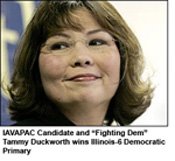 Tammy Duckworth
Candidate for Congress
Illinois (IL-06)
Fighting Dem
Volunteer for this candidate
Contribute to Tammy Duckworth Today!
Go to: Tammy Duckworth for Congress
“Over the years I've seen many strong leaders who have given more to our nation than taken from it. People who lead by example and embody the values that make America so special. Major Tammy Duckworth, a helicopter pilot who just months ago was discharged from the Illinois National Guard, is just such a leader.” - Wes Clark
Tuesday, March 21, 2006
The Fighting Dems: The New Face of the Democratic Party
- from The Free Market News Network, March 22, 2006
by Bernie Quigley
 “ . . . I went out searching . . . looking for one good man . . . a spirit who would not bend or break who would sit at his father’s right hand . . .” Johnny Cash/U2
The Democratic Party was once the party of the real people of this country. The people who grew soybean and cotton, the people who gathered for barbecue at the Legion Hall, who went to church, listened to Johnny Cash, and served without rumination or discussion when they were called to duty.
Here in
But they were perhaps the most important generation in American history. A generation of common men and women made up of every strand of mankind from Africa and
Then something else happened.
I think it was around the time that coffee changed almost overnight from something that cost about 22 cents and came in honest blue paper cups with Greek gods dancing around them to something else, which cost up to four bucks a pop and somehow brought with it the most astonishing pretensions of ending world hunger and saving the Rain Forest. With a cup of coffee like that you were no longer son or daughter of the American everyman, a Fall River factory worker or Alabama tenant farmer, whose life and destiny was changed inextricably when he was called upon to slog through the mud of Italy in the Hitler war. With a cup of coffee like that came a more upscale cultural environment. You were Jean-Paul Sartre and Simone de Beauvoir at Les Deux Magots – much less smoky since Malraux and the others had gone off to fight with the Marquis – and as the world descended around you into burning hell and Nazi occupation, you passed the time while awaiting the revolution by knocking off a one-act play against fascism or a treatise on racism. Right there at the mall in
When liberalism went double latte, regular folk left as if in a diaspora. Prior to that one’s political party was like a religion – the Boston Irish were all Catholic and Democrat.
Perhaps he was right. In 1981 I saw my Irish aunties start to leave the church. They started to vote for Ronald Reagan. In 1985, it was a fait accompli. 49 states full of Southern Baptists and Jewish and Catholic ethnic groups from the urban regions above, all of whom had voted Democratic before, this time voted for a Republican in a time of peace and prosperity. My voting precinct in
But now, in the 60th year since European fascism yielded to American optimism, something else is happening again. The real people of the Legion Hall, the barn dance, the NASCAR track, the Bingo Hall and the church basement supper are again looking around. And a new breed of Democratic politician is coming forth to represent them once again.
Enter The Fighting Dems, men and women of the military and the Legion hall who are challenging Republican incumbents across the country.
As the Denver Post reports, more than 30 Iraq and Persian Gulf War veterans have entered congressional races across the country as Democrats, hoping to capitalize on their military experience to topple the incumbent Republican majority. In December, over 35 Democratic veterans running for Congress got together at a strategy session in
It is interesting and perhaps significant that the reports on this growing phenomenon are largely from outside the Beltway as most of these candidates are. The Chicago Tribune calls them “Macho Democrats.” But this is a grass roots movement and it should be noted that it is first effect was on the Internet.
This week, Tammy Duckworth, a former army major who had both legs shot off while piloting a Blackhawk helicopter in Iraq, won the Democratic primary in Illinois' pivitol race for retiring rep Henry Hyde's seat in Congress. It is a beginning milestone for the Fighting Dems.
I first read about this new movement on Wesley Clark’s web site, WesPAC in August, last year, when
“Paul Hackett is exactly the kind of strong leader we need in these challenging times,” wrote  what it will take to fight -- and win -- the war on terror and keep
“Paul offers the kind of fresh, pragmatic leadership that we desperately need in
Also helping to build this movement is The Daily Kos, which has teamed up with Majority Report Radio to feature a Fighting Dem every Tuesday on its site.
As trends build, this is significant.
Recently both Kos and WesPAC featured Andrew Horne of
“Andrew Horne never sought to be a politician. In fact, the Marine Reserve lieutenant colonel didn't consider it until his latest deployment to
Paul Hackett supports his candidacy, and these men and women support one another.
John Lapp, executive director of the Democratic Congressional Campaign Committee, which seeks to help new Democrats, has coined the term, “Macho Democrats,” says a report in The Chicago Tribune. “Few have any political experience, let alone a fundraising or grass-roots network,” it says. “But with voters unhappy with Bush and Congress, the Democratic strategy is to attack the GOP as an entrenched, corrupt majority, and these candidates say they represent change. More broadly, their resumes might help to dispel voters’ long-held image of Democrats as soft on national security.”
“I think I have fresh ideas and energy I’m bringing to the table,” said Patrick Murphy, a Fighting Dem from
As the Fighting Dems phenomenon continues to grow,
All in all, this is a very auspicious turn for the Democrats. The Big Media, which increasingly speaks with one voice and can hear no other voice, hasn’t quite picked up on it yet. Perhaps because they are all holding their breaths and Waiting for Hillary and right now they can’t think of anything else.
Politics is not a matrix into which you can inject some arbitrary culture or special agenda and make it grow history like hair on a Chi-Chi Pet, as the neocons thought they could grow a new American century in the
It is important for the Democrats to remember that the Whigs did not survive the struggle with the Jacksonians and were replaced by a healthy, vibrant party which dominated the era and still holds the tiller today. And the most important question today in political life is the destiny of the Democratic Party. Recently, the eminent federal reservist Alan Greenspan stated unambiguously that he felt a third party challenge for the presidency would occur in either the upcoming election in 2008 or later in 2012, as both parties today have pushed themselves to their polar extremes, leaving the moderate middle wide open. In Republican convention last week the Republicans committed themselves to their extreme, the great majority giving support to Bill Frist, the senator from
I see only two options: The Democrats can reform and take the center, or a third party (perhaps even with Greenspan’s blessing) will take the day. Third party is risky business, even if such a party came with the blessings of someone with such high public regard as Greenspan. The Fighting Dems can reform the existing party. They offer a better option.
Tuesday, March 07, 2006
The war is over. We won.
Iraq India China and the ascending Asian economic Tigers as important economic allies - not the collapse of the Soviets - which brought a prosperous America China
It is a fact of life that the centuries and millennia begin on even numbers. When they go back and list the 100 best books of the century past they start at 1900, not 1897. Likewise here. No one will remember what happened in 1997 or 1989. The century began at 2000 and its first event was 9/11. The future began with the Bush presidency. The rest is shadow.
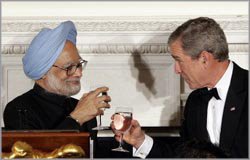 - for The Free Market News Network
Bush's trip to
The
Presenting
Nevertheless, it seems a fairly reasonable approach to the real world. The Bush administration now seems to admit that
Apparently that philosophy has now been abandoned and with it perhaps the political aspirations of the Christian Right have been abandoned by the Bush administration. Bush is and always was only a fellow traveler with the Christian Right. At heart he is really a Yankee sincerely impressed with the deep-feelings of regular religious people in his new home in
The Bush administration, in abandoning the goals of the neocons and going back to a multipolar approach, shows some positive adjustment to the real world in our time. I heard his speech in
Visiting kin in
Such was the call on September 12 - avenge the deaths of 9/11.Go in there and kill a bunch of them and come home. Saddam Hussein in the dock today brings the end game. And truth be told, outside of the Beltway and the Ivory Tower, it doesn't really matter that much if
"Victory" in
Recently, Republicans in Congress have shown a readiness to go after the President on the torture issue, where 90 Senators supported John McCain, and on the
The Republicans now might be able to find a good mainstream candidate. McCain, opposed by the Republican Right Wing, could now get the nomination perhaps if he wanted it. A candidate like
In the near future Bush’s war on
It is a fact of life that the centuries and millennia begin on even numbers. When they go back and list the 100 best books of the century past they start at 1900, not 1897. Likewise here. No one will remember what happened in 1997 or 1989. The century began at 2000 and its first event was 9/11. The future began with the Bush presidency. The rest is shadow.
Thursday, February 16, 2006
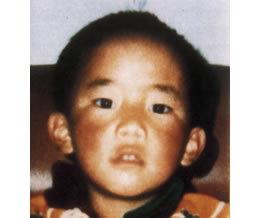 Where is the Panchen Lama? Letter to Jim Leach, R-Iowa and Tom Lantos, D- California
Reps. Leach and Lantos: The hearings on the collaboration of high-tech American companies with the repressive Chinese government move in the direction of responsible corporate management and fair trade and are a welcome step in the right direction. The fate of journalist Shi Tao and his family is particularly important. The fate of the Panchen Lama should be considered as well. FYI, my essay from The Free Market News Network calling for an investigation into the fate of the Panchen Lama. All trade and commerce should be put in limbo until these issues are cleared up.
Send the Panchen Lama to My House
In November, my son and I had the opportunity to hear an address by the Dalai Lama in
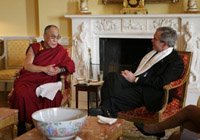 relationships moving forward with
 This child has disappeared. But you will not see his picture posted on the side of milk cartons. Nor do headlines pour forth from the excitable TV press as they should. Instead there is a small web site (freepanchenlama.org) put together by Tibetan Buddhists sent to exile by the Chinese and a few of their new friends in the West. It tells the story in brief: Gedhun Choekyi Nyima was recognized at age six by His Holiness the Dalai Lama as one of
Despite repeated appeals to gain access to him, no international agency or human rights organization has been granted contact with the young Panchen Lama or his family. To date, their well-being and whereabouts remain unconfirmed.
This is a tragic situation, not only to Tibetan Buddhists, but to all freedom-loving people who wish fair play and good business and commerce practices to advance between East and West.
The International Campaign for
It is good that the UN is looking into this case, but I don’t have my hopes up. There are other strategies. The fate of the Panchen Lama should be a key element in the platform of both major political parties and foremost in the Libertarian Party’s, and all trade issues should be linked to the successful and happy conclusion of this dilemma. Paste the Panchen Lama’s face on every piece of sewed cloth that enters port from
If the Chinese don’t want the Panchen Lama he can stay with us. We’ve got plenty of room up here in our old house in
But maybe he’d like 
The best-selling novel, Cold Mountain, by Charles Frazier a few years back made a connection between the sacred mountains in
Surely that marks the travail of the Panchen Lama and the brave Tibetans who lived in silence in the
Would the
I grew up in
But we do care about freedom, and that is the distinction between now and then. Our mills came from
Tuesday, February 07, 2006
The Rise of Sustainable Incompetence
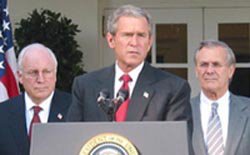 The picture of Muhammad with a bomb for a turban (which took less than 10 seconds to find this morning in a Google search) is unlikely now to send the Danish cartoonist up for a Pulitzer.
I heard the Danish king or prince or something on BBC trying to put the situation into perspective. In a free society, he said, the king or the government has no control over the press. Nice of the royals to join the discussion. Thanks for sharing. But I kept being reminded of an old Monty Python skit in which John Cleese put antlers on his head saying that when the antlers were on his head he was speaking for
Last week when I posted an essay here on Wesley Clark and included part of his “State of the
It is The George W. Bush Political Phenomenon which has brought this out, misguided from the very first and intentionally deceiving a free people. In a vast federation like ours, people have few anchors and are easily deceived – sometimes, like recently, willfully deceived. I’d been watching General Clark for a long time - since before Kosovo, as his relationship with the Army very much reflected what was happening in our country as a whole. Historical periods start at the end of a war – ours started in 1946 – and then they stabilize and develop patterns of power until they reach a plateau and a condition which I call Sustainable Incompetence.
They then begin to form management patterns which always affirm the prevailing wisdom. To do so they must then dispense with all the honor, strength, creativity and intelligence which built them in the first place as it destabilizes the prevailing orthodoxy. William James has written about this in religious organizations but it is the same in politics.
Sustainable Incompetence eventually pervades every culture of management, be it academic, journalism, business or otherwise. The United States Army was a Petri dish for this model. In Sustainable Incompetence, the man or woman of the highest integrity and greatest ability is always the first purged when the management culture starts to descend. Post-war character began to enter its full arc of ascending creativity around 1982, the time of the publication of In Search of Excellence by Tom Peters, a book heavily influenced by an almost mythical fighter pilot, Colonel John Boyd. Around 1994 or 1995 management started promoting incompetence and purging excellence and character.
According to this theory, around the 60th post-war year the culture will elect as President its most incompetent agent, but it has already long been spiraling in a downward trajectory. (Eisenhower thought Nixon too lightweight a character for VP; Nixon thought the same of Bob Dole – we are descending the stairs.) That would be President Bush the Second. I remember his father, who should have known better, when he said at the election of his son to the Presidency that it reminded him of John and John Quincy Adams, the second and sixth Presidents. There was a subtle and probably unconscious presumptuousness to it which instead brought to my mind Louis XIV and Louis the Last.
This current President could conceivable be remembered in history much along the lines of Wilhelm II, pseudo-German and pesky grandson of Victoria, who hated his own English people (as George hates New England, but he is not a real Texan or Southerner, no?) and longed for the glory of Teutonic manliness, with plumes and sword in hand on horseback (“Real men hunt with swords,” my kids say today.) Nobility takes on caricature when honor dies.
When Bush brought up his strategy of “preemptive foreign policy” it echoed Wilhelm II’s language, which so distressed the Germans, that it changed the course of their national election the following week. Wilhelm’s net result was to coalesce latent hostilities of old Christendom into alliances which brought complete disaster to the world for 30 years and brought on a destruction of Europe so great in scale that the Europeans are just now finally crawling out of the wreckage. Any number of advisors from both ends of the political spectrum could have and did predict the results of Bush’s first actions in
The steps ahead were predictable – guerilla warfare, civil war, a pan-Islamic, global anti-Americanism. Now they are even surpassing predictions. Issues took a seismic jump with the election of Revolutionary leadership in
In his late writing, Leo Tolstoy pointed out that if you travel south in
That
John Eisenhower, son of our greatest general since Lee and Grant, has also spoken out. A life-long conservative, he switched parties in this last election to vote in opposition to Bush and the apparent neocon agenda. But for Sustainable Incompetence to reach its objective, it is absolutely necessary for honor and excellence to be purged. And three of our greatest and most honorable military heroes today have been systematically spurned and discarded in the rise to incompetence.
The first was Wesley Clark, purged by a populist army intent on a war with Islam long before 9/11. The second was John McCain, who after sustaining years of torture in enemy POW camps, was called a coward by Christian Right politicians who never fired a shot in anger and never wore the uniform of their country. And third, the man who in our time perhaps best represents
Bush’s first problem today is that he never served in warfare although he apparently supports warfare as a tool of enterprise and policy. I think we should consider real military service a requirement for anyone who seeks high office. There is nothing like the quiet of a 10-year old hootch girl who was selling you rancid ice cream just ten minutes before; now with a still chest so flat to the ground & her head blown off by an unseen assailant trying to kill you or somebody else. It stays with you. It quickens the intellect and the moral initiative and matures them together throughout adulthood. Such an experience would bring perspective in a political leader seeking war a second time.
Had Bush served when he was young and was expected too he would have learned at an early age what kind of a man he was.
This is the problem today with all of the President’s Men, Rumsfeld in particular. (Don’t lets hear now how brave he was flying T3s around
These men had every opportunity to serve in war and every opportunity to avoid it. We know what Bush was doing. He was drunk. And this should not be allowed to be turned into pop-culture and revival-tent salvation: “I was drunk, but now I got Jesus!” It is time to talk straight and leave salvation to the Oprah show. There should be instead psychological testing for anyone who wants to be President. I’m glad the President has sobered up, but psychologists and Alcoholics Anonymous tell us that alcoholics often switch one obsession for another, quite often a religious obsession. Perhaps he missed some of the 12 steps.
Vice President Dick Cheney, who told Washington Post reporter George C. Wilson in 1999, “I had other priorities in the ’60 than military service,” probably set the record for deferment. He showed real promise as a
I think history will go back and look at two men together, Cheney and Powell, who worked together early in their careers and who both have long service in government. And we will see
In a large federation like our own, the will of the people is hard to change. It is like a big Destroyer trying to turn around – but when it does turn it is fierce, as we are a fierce people because we are a new people. And when it does turn it turns again to the people first spurned; the men and women of the highest character and keenest intelligence.
My instinct is that our country is not yet ready to fail and the best will not be left behind. Wesley Clark, John McCain and Colin Powell will yet have important roles to play in our American destiny. These are men of honor and authenticity, not fancy, dress up, caricature and wish fulfillment.
Friday, February 03, 2006
Letter to a friend
 Carol – I wanted to let you know that since I published that
 Clark essay at the Free Market News Network two days ago I have received over 25 emails from readers on my blog and at the Free Market News Network & they are continuing this morning. I don’t ever remember that publication getting so many responses. And it is not a venue that is necessarily particularly friendly to General Clark. I usually only get one or two responses, usually none. It shows what a need there is for a new direction. I sent the essay to Charlie Rangel’s office – perhaps he can use it. I usually don’t write about politics. I am a Buddhist and write generally about art and Tibetan Buddhism (Quigley in Exile) and long-term patterns of history. Was only Boy George what brought this out, misguided from the first and intentionally deceiving a free people. I write about history as shapes and packages over long terms and kinds of governments – federalism, regionalism, monarchy – as distinct kinds of psychological packaging, each with their own consequences for people. In a vast federation like ours, people have few anchors and are easily deceived – sometimes, like recently, willfully deceived. I’ve been watching General Clark for a long time - since before Kosovo, as his relationship with the Army very much reflected what was happening in our country as a whole. Historical periods start at the end of a war – ours started in 1946 – and after they stabilize and develop their patterns of power, they reach a point of what I call sustainable incompetence – they form management patterns which always affirm the prevailing wisdom. To do so they then must dispense with all the honor, strength, creativity and intelligence which built them in the first place as it destabilizes the prevailing orthodoxy – William James writes about this in religions but it is the same in politics – the army was a Petri dish for this model – and the man or woman of the highest integrity is always the first spurned by the “descending” management strategy. Industry, college administration, car culture, politics, etc. all take the same direction – they began around 1992-3 promoting incompetence and purging excellence and character. Around the 60th post-war year the culture will elect as President its most incompetent agent, but it has already long been on a downward trajectory (Eisenhower thought Nixon too lightweight a character for VP; Nixon thought the same of Bob Dole – we are descending the stairs). That would be Boy George. George could conceivable be remembered in history much along the lines of Wilhelm II, pseudo-German and pesky grandson of Victoria, who hated his own English people [as George hates New England, but he is not a real Texan or Southerner, no?) and longed for the glory of Teutonic manliness, with sword in hand on horseback (“Real men hunt with swords,” my kids say now.) Nobility takes on caricature when honor dies. When George brought up his policy of “preemptive foreign policy” it echoed Wilhelm II’s policy; Wilhelm’s net result was to coalesce latent hostilities of Christendom into alliances which brought complete disaster to the world for 30 years and brought the destruction of Europe . Any number of advisors could have and did predict the results of Boy George’s first actions in Iraq Iran and again in Palestine Russia Russia will team with Iran New Jersey or wherever as a ROTC officer twix and between Korea and Vietnam
 Carol – I wanted to let you know that since I published that
 Wednesday, February 01, 2006
Wes Clark’s World and Bush’s
 I had a small epiphany a few years back when Ryutaro Hashimoto, Prime Minister of Japan, was forced out of office in a political scandal and he used these words on television. “I take complete responsibility. I resign.”
Wow. I gathered my children in front of the TV. We have heard that phrase many times before and since, but only the first part of it: “I take full responsibility.”
When we hear it now it means nothing. The last two Presidents have used it and many before. Usually today it means that none of the accomplices in the dastardly deed are going to get fired or go to jail. Even cowardly acts like those of the current President’s Men who publicly revealed the name and cover of a covert American agent and endangered the lives of others – a treasonous act for which they would have been taken out and shot a shot in the Korean War - have virtually no consequences.
Listen to this I told my kids. The Japanese Prime Minister takes full responsibility for his failure. He resigns.
Of course, a hundred years earlier, Hashimoto would have been given the option to throw himself on his sword, to save himself form the disgrace of living in the society he had betrayed. But the code of honor was stronger then and even
Today corruption is an everyday part of life. Sin happens. But in an honorable society a leader takes responsibility for his actions. He acknowledges his failure to himself, to his family, to deity and country. He relinquishes the reins of power.
We are no longer a society which honor’s honor. Recently, I had a conversation with a very decent, intelligent and thoughtful young man who said he didn’t have any idea what I meant by honor. We live in a nation of laws, he pointed out. Honor has nothing to do with it. I think he explains it precisely. It is an American dilemma. Can a country live by laws alone? Our country does, but in each segment of our history laws have ultimately failed us and we have had to call upon men of honor at the hour of desperation: Washington, Lincoln, Eisenhower, George Marshall. Very often they were military men.
The high Victorians lived by a code of honor, well expressed in its prelude by Lord Nelson, who said, “
The President tells us, “Americans are addicted to oil.” I think we have been telling him that for the last five years, since he hired oil men and car guys from
"In a complex and challenging time, the road of isolationism and protectionism may seem broad and inviting, yet it ends in danger and decline," he said.
How did we become so isolated? As I recall, six years ago we had more friends than we desired, sneaking into our country in tunnels and crashing ashore at Far Rockaway in leaky boats. Now we have new anti-American states again to our South and
Most confusing was the phrase about
The tenor and tone of the entire speech was to turn away. He seems one foot in Crawford, cutting brush, waiting for the next three years to end. As do so many others.
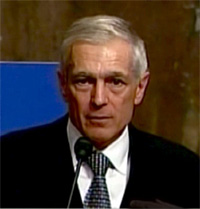
I turned by contrast to Wesley Clark. Two days before President Bush was to give his annual State of the Union speech, Wesley Clark was invited to deliver a speech at The New America Foundation in
General Clark is old school. He lives by the rules, but he also lives by a code of honor. It pervades every utterance and every act. I heard him speak a number of times in the
This is some of what Wes Clark said in his State of the World:
“Today, billions of people abroad believe that
“Because four years after 9/11, Osama Bin Laden remains on the loose in the fastness of western
“Because the threat of terrorism has actually increased, partly as a result of the unnecessary invasion of
“Because, despite our tough talk,
“Because,
“Because, in the process of this struggle against insurgents and terrorists and the proliferation of nuclear weapons, we are in danger of losing the very principles we are fighting for as revelations of torture and degrading treatment of those detained confound our long standing commitment to human rights and undercut our moral strength and leadership.
“Because America's long-standing commitment to assisting democracy abroad was recklessly transformed into hot rhetoric and direct action in Iraq— and it has not only offended cultural and national sensitivities in the Middle East, but it is also contributing to the anger and violence in the region.
“Because while we are distracted by the war on terror,
“Because the United States has stood silently while the historic opportunity of a democratic Russia is systematically crushed and other new democracies threatened by the same power ministries and entrenched authorities that enslaved hundreds of millions during Communism's long reign.
“Because our oldest friends and Allies, in Europe and Asia, are questioning America's commitment to the dialogue, institutions, and principles that kept us safe throughout the Cold War and even helped end ethnic cleansing in Europe during the 1990's.
“The plain truth is, in
As our nation opened,
Tuesday, January 31, 2006
Wesley Clark: The Real State of the Union
Two days before President Bush is to give his annual State of the Union speech, Wesley Clark was invited to deliver a speech at The New America Foundation in Washington, D.C. It is a great speech. It could bring a turning point. Here is the text in full.
Two days before President Bush is to give his annual State of the Union speech, Wesley Clark was invited to deliver a speech at The New America Foundation in Washington, D.C. It is a great speech. It could bring a turning point. Here is the text in full.
THE REAL STATE OF THE UNION 2006
THE NEW AMERICA FOUNDATION
Monday, January 30, 2006
General Wesley K. Clark Addresses New America Foundation Audience (1/30/06) on Capitol Hill: "The Real State of the Union 2006"
Thank you for that kind introduction. And thanks to the New America foundation for getting us together today to discuss these important issues.
It is a privilege to be with you this afternoon to address the state of our Union, to offer an assessment, and to tell you how the our Union can be great again -
For today we are into our fifth year of war abroad and threats at home, and the state of the union is not what it should be, and not what it could be....
I want to express my admiration and appreciation for the men and women in our Armed Forces, and their families. They have served with courage and honor and with incredible skill.
They have volunteered, and served selflessly. Over 2200 have died in Iraq, others in Afghanistan, and tens of thousands have come home with the injuries and scars — physical and mental - that will mark them forever.
Won't you stand and join me in recognizing them, and all our veterans, with a round of applause?
A few weeks ago, as I rode across the Queensboro Bridge into Manhattan, the Pakistani-born cab driver interrupted my thoughts with his own story and reminded me why we all should feel this sense of privilege to be here in America....
"We came as three brothers," he said... "we came nine years ago...only I am still driving a cab....we own a store now, and a restaurant, and soon I will join the others full time in the restaurant....when we came we had nothing, but today....Only in America," he said, "could we do this, ONLY IN AMERICA!"
His story is the story of hundreds of millions of us and our forefathers who came here from somewhere else, who dreamed, dared, planned and struggled to forge new lives, raise strong families, and together, generation after generation we have built a great nation... exceptional…unique.
We are a nation where liberty is protected by the Constitution, a nation where people choose their own leaders, and a nation where government's power is limited. Generation after generation, America has throttled the self-serving impulses of the powerful and restrained the powerful passions of the multitudes, thus guaranteeing that the freedoms and opportunities of every citizen enumerated in law are provided in practice.
And in the process America has become a Beacon of Hope for people everywhere.
Unlike the taxi driver, I was born here. I learned to love this nation as a youngster growing up without a father, at a time when all our institutions and values were under attack by Communism.... I loved this nation enough to serve as a soldier, to come home from war on a stretcher, enough to stay in uniform for another thirty years....
My family and I lived in Germany, Belgium, and Panama, in Kansas and Kentucky, in Virginia and California, in Texas and New York.
Over time, like other officers I was given increasing responsibilities for others, commanding units, teaching courses, providing staff advice and assistance. We were at various times responsible for the work they did, the lessons they learned, the health care they received, the homes they lived in, the schools their children attended, the lives they led... and I learned about our country, our people, and how we are perceived in the world.
I was so proud to represent America in uniform....
And this is why today, I come before you with concern.... not in a spirit of partisanship, but because our nation is in trouble, veering from its heritage, and sliding into a dangerous future.
It doesn't have to happen this way, but we can change course only if we speak honestly and directly about what's gone wrong, and why, and how we must change, and then reach across Party lines to bring the American people together.
Today, billions of people abroad believe that America's beacon is fading, our star is dimming, and that America's time is passing. Why?
Because four years after 9/11, Osama Bin Laden remains on the loose in the fastness of western Pakistan, and Al Qaeda remains a potent force among millions of Muslims.
Because the threat of terrorism has actually increased, partly as a result of the unnecessary invasion of Iraq, where after almost three years, we find ourselves enmeshed in an intensifying sectarian struggle that is drawing in jihadi terrorists like a magnet and creating a new cadre of hardened opponents to America and our friends.
Because, despite our tough talk, Iran is discarding its international obligations in the apparent pursuit of nuclear weaponry, while simultaneously questioning Israel's existence and raising the specter of wider conflict in the Mideast.
Because, North Korea, with a standing army of more than 1 million men, armed with chemical and biological weapons as well as long-range missiles, is defying US efforts to contain its threat of nuclear proliferation.
Because, in the process of this struggle against insurgents and terrorists and the proliferation of nuclear weapons, we are in danger of losing the very principles we are fighting for as revelations of torture and degrading treatment of those detained confound our long standing commitment to human rights and undercut our moral strength and leadership.
Because America's long-standing commitment to assisting democracy abroad was recklessly transformed into hot rhetoric and direct action in Iraq— and it has not only offended cultural and national sensitivities in the Middle East, but it is also contributing to the anger and violence in the region.
Because while we are distracted by the war on terror, Iraq and Afghanistan, rising global competitors like China are taking advantage of the security umbrella we have created to lock in their own access to the resources needed to fuel their stupendous growth.
Because the United States has stood silently while the historic opportunity of a democratic Russia is systematically crushed and other new democracies threatened by the same power ministries and entrenched authorities that enslaved hundreds of millions during Communism's long reign.
Because our oldest friends and Allies, in Europe and Asia, are questioning America's commitment to the dialogue, institutions, and principles that kept us safe throughout the Cold War and even helped end ethnic cleansing in Europe during the 1990's.
The plain truth is, in America's rhetoric and conduct since 9/11, we've made more enemies than friends in the world - and that's no way to protect the American people!
And all of this at a time when Americans are more dependent on events abroad than ever before: the war in Iraq; the daily notification of losses; the threat of another terrorist incident; the rising price of gasoline, a global economy.
And here at home, to speak candidly, that beacon of hope is flickering also.
Again we ask why.
Because we're losing our manufacturing base in America, and failing to face the realities of a global labor market, international trade and capital flows which are robbing millions of Americans of income security and have mired us ever deeper in debt.
Because, while, statistically, the unemployment rate may be a little below 5% now, according to the way the Administration measures, these figures mask millions of people in the ranks of the long term unemployed, or trapped in low wage jobs, or underemployed in jobs which fail to use their skills.
Because even highly skilled jobs in the so-called knowledge industry are moving abroad, with big firms like Microsoft and GE as well as thousands of highly competent foreign-born, US educated entrepreneurs and business leaders seeking new talent, lower-cost labor and less competitive, friendlier business environments.
Because at home more than 45 million Americans lack access to health insurance, a profound systemic failure and imposes a staggering human cost on those least able to bear it and drives businesses offshore.
Because both our infrastructure and our system of public education lack essential modernization and reform, caught in a squeeze between rising costs for salaries, supplies, construction and repair, and rising federal deficits.
Because despite over thirty years of warning, this nation still has no policy to lead us to energy independence and away from the volatile and conflict-ridden regions where, today, the "geostrategic risk premium" is adding billions of dollars to the costs imposed on the American people.
Because the legal protections for the environment and natural resources on which so much of our economic welfare depends have been steadily undercut by new laws and policies, even as the Administration has tightened restrictions on the scientists and analysts who could tell us of the dangers ahead.
All this is common knowledge.
But what perhaps most surprising this year — despite the skill and dedication of our civil service, diplomatic, and military personnel - was the tragic incompetence of our government: failing effectively to assist the states in the terrible humanitarian catastrophe of Katrina, stumbling through a repetitive cycle of inflated rhetoric and crushing disappointments associated with reconstruction and reform in Iraq and the Middle East, and frustrating millions of American seniors floundering through a poorly designed and badly under resourced Medicare prescription drug program.
Even worse, has been the emergence of what appears to be a culture of corruption reaching from lobbyists, through the Republican leadership in Congress, and into the White House itself.
No wonder so many believes that America is a nation in trouble, squandering our precious resources in a destructive and unnecessary conflict abroad and a spendthrift economy at home. We are, they say, neglecting our future, failing in our duty to our children and grandchildren, and denying them the opportunities to dare, to dream, to achieve and create that our generation and our predecessors have enjoyed.
And they have a strong case.
What has happend to us?
We Americans can no longer hide behind our oceans, or pretend that the dialogue of politics should be confined to disagreements about domestic policy alone. And as for the partisan charge that Democrats are living in a pre-9/11 world, let us be very clear: the policies followed by this Administration since 9/11 - the belligerent tone, the unilateralism, the excessive reliance on military force are not making us safer; they are increasing the dangers we face abroad and distracting us from the most important challenges here at home.
From the late 1940's until the early 1990's, America led the world in winning an historic struggle, a victory in the Cold War against the tyranny and oppression of Communism.
We were guided abroad by a largely bipartisan strategy of containing the spread of Communist ideology, deterring the Soviet use of force, and supporting those who shared our values. And at home the stress of this titanic struggle inspired efforts in science and technology, industry, agriculture, education, health and fitness.
Over a period of forty years we persevered — through diplomacy, alliances, ideological struggle, and armed conflict in Korea and Vietnam. And in the end, we won — the Berlin Wall came down, the Soviet empire collapsed, and the Soviet Union disintegrated into 11 separate states.
It was the triumph of American ideals — of the nobility of the human spirit, the priceless significance of freedom and human rights, and the incredible creative force of a free-market economy.
But when we defeated our old adversary, we not only lost our opponent, we also lost our strategy — our organizing principles — the animating principles of our society, and much of the cohesion that held our world together.
Oh, we did well economically in the 1990's, creating jobs, reducing poverty, balancing the budget - but the United States never quite put in place another strategy, another publicly understood, bipartisan set of principles which could guide America's policies at home and abroad, and take us safely into the future. We had taken economic advantage of the global opening, but we really didn't understand how to mitigate the many strategic risks it brought along.
And then, four and a half years ago this nation was viciously attacked in a serious of terrorist hijackings of airliners that resulted in three thousand innocents' deaths. 9/11 was an act of war.
Action was required. America struck back at the terrorists who attacked us and the Taliban government in Afghanistan that supported them.
And we should have.
But, soon the errors began:
- Letting Bin Laden slip thru the noose at Tora Bora, in December, 2001 and failing to commit sufficient forces to Afghanistan to finish the job there gave the terrorist movement continuing stature and enabled a host of local imitators to ride his coattails of impunity.
- Naming an "Axis of Evil" helped drive the North Koreans and Iranians to accelerate nuclear weapons efforts and probably spurred a deepening cooperation, even as the term itself offended allies and convinced millions around the world that a just American effort against those who attacked our country was being transformed into a self-righteous moral crusade against those of different religious convictions or geostrategic alignment.
- Invading Iraq, neglecting North Korea, and ducking the diplomacy on Iran — and labeling it all with a bellicose-sounding strategy of preemption left us concentrating the greatest resources on the least urgent strategic problem and doing so in a way that has exaccerbated the threats we face.
- Ignoring our European allies and sidelining NATO left us bereft of the strong Allied support necessary to succeed in Iraq and simultaneously meet challenges elsewhere.
- Pushing through a series of deep permanent tax cuts using the pretext of a temporary recession have prevented us from addressing urgent issues at home and shoved the nation into long term and unsustainable budget deficit.
- And in the press of partisan politics, the governing party has elevated the role of money in American politics higher than ever before, encouraging a "pay to play" culture of corruption and aiming to control the political agenda with a ferocity almost unprecedented in American history, undercutting the common good and threatening the very Constitutional principles which guard our most precious freedoms.
What's gone wrong? In the last five years we have seen leadership without vision or foresight, a backwards look to tough talk and excessive unfair tax cuts, and a misguided idea from the 1990's that uncooperative Middle East regimes could be "cleaned up" by American military action.
And at the same time we've seen such partisanship that many believe that this Administration lacks the basic decency to respect its political opponents, and the fundamental integrity to adhere to common standards of transparency, honesty, and ethics in government.
Enough is enough!
Americans are ingenious, energetic, pragmatic, and almost inevitably optimistic. But they are also keenly aware of reality — and today a strong majority disapproves of the way our President and the one-Party rule on Capitol Hill are leading the country.
WE CANNOT AND MUST NOT STAY THAT COURSE.
A Forty Year War on Terrorism — which I have heard trumpeted more than once in this town — and which may well be required, particularly if we continue on this course — simply fails to provide the comprehensive strategy and framework — comparable to deterrence and containment in the Cold War - necessary to direct American policy abroad or guide needed change at home. We are a nation adrift, and America senses this.
Here's what we must do.
First, we've got to set things right at home. Protecting our Constitution comes first. Country before Party. Congress must fulfill its duties to the American people, not rollover for favors from the Executive branch. We need a full, in-depth, bipartisan investigation of the Administration's bypassing of the Foreign Intelligence Surveillance Act.
Congress needs to show resolve that the laws it passes do bind the executive branch, whether in wiretapping, humane treatment of prisoners, or the freedom of information act. Moreover, it is time for a special prosecutor, independent of the Department of Justice, to be empowered to investigate the Abramoff scandal, and pursue the leads all the way through Congress and up to the highest office in the land, if necessary. Get it out and get it over.
Then, we have to focus on the principal challenge ahead: preparing our nation to succeed in a 21st Century world where capital and technology flows instantly across borders, where the labor market is global, and where the benefits and security Americans have taken for granted are put at risk as supergiant countries like China, with 1.3 billion people, grab resources, spur their own economic growth, redress old grievances, and naturally pursue their own interests.
Today, we are indisputably the world's most powerful nation, but how we organize and prepare America at home, and provide leadership abroad, in the face of China's growing power, is the real and enduring challenge that 21st Century America must answer.
Can we protect that which we value, welcome and profit from China's growth, maintain our own security, and avoid the conflict and war which has so often accompanied historical changes such as we will witness? I believe we can, if we see clearly what must be done and bend our will to do it.
It begins at home, for this is where the most intractable problems lie, with public education, health care, and creating a business environment that encourages innovation, growth, and the creation of meaningful valued jobs.
-In education, we should be offering public preschool across America, encouraging renewed study of mathematics, sciences and engineering, and reform and change must be deep and fundamental creating the community programs needed to assure that every American child graduates from high school.
We must commit more resources to public education — not pull them away with voucher programs - but the most important resources are not financial — they are the commitment of community leaders to create public schools emphasizing learning and character, and the commitment of parents to work with their children, to assure they are fully engaged in the classroom and at home in preparing for their own productive future.
We need to reward teachers for their skills and commitments, but the best form of teacher accountability is not found in standardized testing but in the dialogue between teachers and parents centered on the love and respect for each child in the class. And no student who seeks to go to college should be denied that opportunity because they can't pay.
-In health care, we need to take better advantage of modern technology to practice evidence-based medicine, in which treatments and practices are based on statistically proven results — not commercial advertising — and doctors and hospitals are held accountable for their performance, not just by the threat of malpractice but by the day-to-day quality of their results.
We need to harness the innovation of our biotech, pharmaceutical, and health insurance industries better to serve the public good, not just the private gain of shareholders. No child in America should grow up without regular medical check-ups and care — or regular exercise and physical fitness - and every adult should be provided access to the kinds of diagnostic testing and preventive treatments which can slow the onset of aging diseases like diabetes, atherosclerosis, and Alzheimer's. Additional insurance coverage should be directed to catastrophic illness and injuries, the kind that wreck families and shatter productive lives.
And inevitably this will mean transitioning over time from a work place centered, private payer system toward greater reliance on some form of single-payer system to ease administrative burdens and reduce costs.
-In the business community, we must spur research, development, and innovation, and the growth of the small companies that provide the majority of US employment. This will mean more private-public partnerships in developing new technology, and in linking our universities to business enterprises, as well as an expanded arsenal of economic and tax incentive programs aimed primarily at small businesses.
We must assure investments in the technology infrastructure — the broadband and wireless access improved and modernized highway, air, and rail transportation systems, and the access to affordable, reliable sustainable energy essential to continuing economic development.
We must have a real plan to achieve "energy independence."
And we need to do so without further damaging our fragile environment.
In fact, sustainable energy and so-called green engineering provide major growth opportunities for American ingenuity, and we must move in that direction.
We must chart a new path for labor in America, and probably for the union movement itself.
While workers still need help in redressing grievances against management, perhaps the old dividing lines make less sense in an age of high technology, social and geographic mobility, and global competition.
Is it possible that unions could become the "development agencies" for workers, protecting their rights, but also promoting their training, education and career development throughout a lifetime of many different skills and jobs? And if they don't who will.
For we know that in today's economy learning is a lifetime process and every American in the workplace must take increasing responsibility for his or her own development of skills, pursuit of opportunities, and creation of financial security for the family.
-And to address these and many other issues, our government will need more resources, for the great discovery of twentieth century America was not that we should get "government off our backs" but that government's could be a partner in the economy -in infrastructure, in regulation, in research and development, in education, and in health — laying the foundation for the achievements of private industry. In particular, we need resources to empower our people, with new programs comparable to the landmark contributions of the Homestead Act, the GI Bill, and the 30 year Mortgage in order to give every child in America a head start in education, business, home ownership, investment, and economic opportunity.
But we must raise resources in a way that protects the most needy and working families, and that still provides opportunities for the creation of the wealth that is the hallmarks of the American dream.
America's great strengths are our economy and the spirit of our people. And if we take these major, fundamental measures, we'll be well positioned to cope with the economic challenges of China's rapid development.
But we must also take other, urgent steps to assure America's security now.
Turning first to the Middle East, we need to use American military commitments to broker political arrangements that bring the Sunnis back into the Iraqi political system, delegitimate the insurgency, and reduce the threat of escalating civil war. We should create a regional security dialogue, in which we and the Iraqi government can hold real conversations with neighboring states, including Iran and Syria.
A substantial US troop presence will likely be required for years — and I am mindful of the sacrifices that we are asking from the men and women in the armed forces and their families.
It is a heavy burden, and they alone have been asked to bear such sacrifices - but we should draw down as rapidly as political objectives can be achieved and Iraqis can secure their own country.
Today, Syria presents an historic opportunity for the United States. Rather than just threatening Syria, we should talk directly to Bashir Assad, encouraging him to lay the foundations for economic and political opening and gradual transformation, cut off insurgent access through Syria into Iraq, and end the sponsorship of Iranian-backed terrorist institutions, in return for stabilizing his administration during the ongoing UN investigations.
And this in turn, will give us greater traction against Iran's steady march toward nuclear weaponry.
But actions on Iran are urgent.
We should join now — right now - in opening new talks with Iran, in which we ourselves participate, before pressing for UN action or moving toward the military option. No one should be mistaken: there is a military option.
We can strike hard enough to set back Iran's nuclear quest by many years, and take out much of their military capacity in the process. And we can at the same time protect most of the oil flow from Iran and deny their capacity to block transit through the Straits of Hormuz. But we also must recognize the possible consequences of this action: an embittered, vengeful Iran, seeking further destabilization of the region. Far better to pursue dialogue now, whatever the precedents, and save the military option for truly last resort. Understand: unlike others you may hear, I know when and how to determine our course with Iran.
As for Israel and the Palestinian people, there is no longer a "road map to peace." But Israel is increasingly secure.
It is now up to Hamas to form a government for the Palestinians. But they should be under no misunderstanding. Hamas is an international outlaw so long as it demands Israel's destruction.
The war against terrorists will continue, as it must. But it should be conducted with a new resolve to use diplomacy, local authorities, and international cooperation among law enforcement and intelligence agencies, reserving military forces only as a last resort.
Ultimately, we will not prevail in this war by killing terrorists — though that may need to be done — but rather by winning the battle for greater tolerance, understanding, and respect between peoples of differing religious convictions. It is first and foremost a battle of ideas. We need to bring terrorists to trial. And we must carefully guard our own values and principles, for in this struggle, moral leadership is far more valuable than pittances of information gained by compromising our beliefs.
We are still in danger from events in Southwest Asia.
We need to cooperate with Pakistan to eliminate the new terrorist base area forming along Pakistan's frontier with Afghanistan, and sustain an enlarged commitment to Afghanistan for many years.
But more fundamentally, we need to redirect the main thrusts of American efforts abroad. We need to rebuild our ties with Europe, with NATO as the foundation, and a new Atlantic Charter as the means. Europe is our "base," more than 400 million people with whom we are the most closely aligned in terms of values and interests, economics and power. Together we can move the international system. Isolated, alone in a multipolar world, America simply won't fare as well. And we should strengthen ties with India, the world's largest democracy and itself a rapidly developing superpower.
If we are to avoid the reemergence of a 19th Century balance of power system replete with threats and warfare between states and alliances, we must use this period of American preeminence to rebuild the system of international laws and institutions which two generations of American leaders fashioned and extolled. We should set the example in shaping and obeying international law. Likewise, we should lead in the reform of the United Nations, seeking its full potential as a place for dialogue and the expression of values, and as the source for international law and humanitarian assistance in emerging crises.
Fellow Americans, although our nation is incredibly wealthy and uniquely powerful, we are at historic turning point. Facing multiple near term crises and a great and long term challenge to our very identity as Americans, we have critical choices to make.
Will we choose to emphasize boastful rhetoric or constructive engagement abroad? Will we lash out in anger with military force, or will we pursue every reasonable avenue to avoid the terrible destruction of war? Will we fight fire with fire," relying on the means and techniques of our adversaries, or live and lead by the higher standard of the values we have professed?
At home, will we persist in shortsighted partisanship, or will we follow a stronger vision to the deep reforms needed to secure our future? Will it be selfishness or teamwork that is our rallying cry?
These are the choices before us.
I welcome the opportunity to participate in this great American adventure as we seek our destiny.
America's Beacon of Hope must shine brightly once more, lighting our beloved country and illuminating the whole world.
And if we choose wisely, it will.
Subscribe to:
Posts (Atom)