Friday, December 07, 2007

From Quigley in Exile, repeated on the 27th anniversary of his death

On the 25th Anniversary of His Death:
Free as a Bird: John Lennon's Unfinished Journey

"Is it not written in your law . . . you are gods?" John 10:34

"The crosses are all full," said the lay brother.
"Then we must make another cross. If we do not make an end of him another will, for who can eat and sleep in peace while men like him are going about the world?" -
"The Crucifixion of the Outcast," Celtic tale retold by William Butler Yeats in Mythologies

"Zen demands intelligence and will-power, as do all the greater things which desire to become real." These are the words of C. G. Jung in the introduction to D.T. Suzuki’s An Introduction to Zen Buddhism. Jung’s words and observations would win him a place top row center, right next to Edgar Allen Poe, on the cover of Sgt. Peppers. In the 1950s Suzuki was always referred to as Dr. Suzuki – much as Richard Gere is referred to as only Richard today by Tibetan Buddhists. It is kind of an honorarium, a title. Dr. Suzuki was a solid forefather on the path East and one of the very first learned Masters to come from the East to the West.
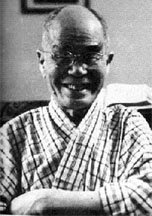
In the 1950s he taught at Columbia University and was a celebrity in New York City, an exotic but common monk with a great smile and a pure vision of Zen. Personal experience is everything in Zen, said Dr. Suzuki. No ideas are intelligible to those who have no backing in experience. Mystification is far from being the object of Zen itself, but to those who have not touched the central fact of life Zen inevitable appears as mystifying. Penetrate through the conceptual superstructure and what is imagined to be a mystification will at once disappear, and at the same time there will be an enlightenment known as satori.

Dr. Suzuki talked straight: personal experience is everything in Zen. The purpose of life is love. I’m not sure if John Lennon read these words but perhaps his wife, Yoko Ono, did. She was a key figure in the avant garde art scene in New York City at the time and had been in New York for a long time, even as a student at Sarah Lawrence. She was well known as a conceptual artist before she met John Lennon, and lived and worked in the same realm as people like John Cage and Marcel Duchamp. These would be the first people in New York to listen to Dr. Suzuki.

The art students were always the first to catch on, and John Lennon and his friend Stu Sutcliffe were the art students who started The Beatles. They were like pilot fish for the rest of us who were born at the end of the war and it was quite a large school of fish. 40 million people. All our fathers had been warriors. We were all the same age and born within months of one another, conceived by men who had been a long time without women, directly on return from war in Asia and Europe.

For us it was a bristling, exciting respite between childhood and adulthood and we were interested in new things. There were no teachers around to deflect our learning, no priests to lead us astray. For the briefest period, all of the shields were down. Other voices would come shortly. Swami Yogananda, who wrote The Autobiography of a Yogi, would become very popular for awhile. John said he read about half of it, which I thought was pretty good, as I’d only managed about 80 pages. Later, the Maharishi Mahesh Yogi and Tolstoy. But Suzuki’s message entered the river of our generation at the same time as John entered our river. At first much of the Zen around New York was dark, misunderstood in the West as nihilism, the shadow which withered the Western heart after 500 years of exploration and dominance. But John and Stu understood Dr. Suzuki’s Zen message that love is the purpose of life.

John is said to have started The Beatles to have something to do with Stu. When McCartney entered the group he drove them to become more serious and businesslike. But at first it was always John and Stu. Stu had the artist’s eye for style – naming the group The Beatles after seeing Lee Marvin and Marlon Brando in The Wild Ones. Lee Marvin’s motorcycle gang was called The Beetles. Stu always attracted the coolest people as well. And when they went to Berlin before the group was fully formed he attracted the beautiful photographer Astrid Kirchherr, who would become an anima figure – a muse – to the group and open them up in the mind in new ways and awaken new music and images.

An avante garde photographer in Germany, she and her friends, including Klaus Voorman, traveled in the seedy night scene in Berlin and met the group there, which was still going under the name of The Silver Beatles. She gave them the playful Beatles haircuts. Friendship would bind them. Stu married Astrid and Klaus later drew the cover picture for the Revolver album, and much later, after The Beatles had broken up, he played as a background musician on the Imagine album.

Personal experience would guide the fledgling poet as well, and like many ordinary men before him, Lennon became great when someone he loved died. He would remember them all. And he would remember Stu, who never returned to England with them.

I know I’ll always feel affection, for people and things that went before. I know I’ll always think about them.

But it was different with Stu.

In my life, I loved you more.

This requiem, this love song, is considered today to be one of the greatest songs ever written. It is the beginning of the artist’s journey for John Lennon.
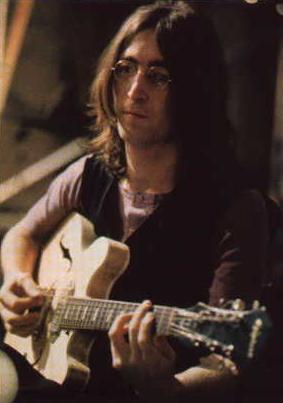
The Sixties was a cacophony of a million sounds and smells and voices and music and colors and textures, but especially music. The electric guitar was like a key; an ancient iron ornamented key to a mediaeval dream door that would open to an age.

Every age, be it short or long, has a beginning, a middle and an end, like a person’s life, and this age was no exception. This age, someone pointed out, came with its own sound track. And it rose and fell rather quickly.

At the center was The Beatles and the Sixties rose and fell with the fate of the Beatles. And at dead center, the man in the center of the Beatles was John Lennon.

From beginning to end The Beatles was about John Lennon. He was not the most important innovator or instigator of the period, except perhaps in music, but the music would eventually become secondary to his life, as literature had become secondary to Tolstoy.

He was one of us, common and working class, but of course, more gifted. And the transformation he made, we made. Eventually he left The Beatles behind to complete the passage himself. He was the Man at the Center who made passage with us and for us and completed the journey on our behalf. And I don’t think we could have or would have completed passage without him.

The remaining Beatles say they were transformed by Bob Dylan like the rest of us were. John was as well. It shows in his pictures. It shows in his clothes and in music like Norwegian Wood, a folksy, spare song inspired by the folk scene, written when the Beatles would begin to rise to a higher artistic level. John, they say, wanted to conquer the world, which The Beatles did with ease. Then, when they heard Bob Dylan, they aspired to be artists.

Dylan opened the gate and performed the Rite of Entry to the age with his soulful cohort Joan Baez, and the age rose to the center when The Beatles reached their artistic apex. Then followed the rite of exit with Joni Mitchell and the howling animal cries of Neil Young, mourning the passing of the brief and sacred moment.

The Beatles, at the top of their creative arc -- that would be somewhere within the Sgt. Peppers area -- brought the defining moment to a generation. Some 30 years later, in January, 2001, New York Times columnist Maureen Dowd contrasted the generation with George Bush, Jr., who last week threatened to cast the first veto of this presidency to overthrow Congress’s attempt to ban his policy of allowing the torture of military prisoners.

In his first month in office she wrote, “He said he never liked the Beatles after they got into that ‘kind of a weird psychedelic period.’” One either crossed the river or did not, and those who did not, struggled to create a counter-force. (Ten weeks into his presidency Dowd reported going hungry for a shred of modernity. “Bush II has reeled backward so fast, economically, environmentally, globally, culturally, it’s redolent of Dorothy clicking her way from the shimmering spires of Oz to a depressed black-and-white Kansas,” she lamented. “What’s next? Asbestos, DDT, bomb shelters, filterless cigarettes? Patti Page?”)

Not unlike George Bush, John Lennon was preoccupied with Jesus. You could see it early on with the trouble he got into when the Beatles were first big. Fans would crowd them and overwhelm them and once John said to a crowd of reporters, “We’re more popular than Jesus.” There was no arrogance to it, but subtle awareness. The Beatles were more popular than Jesus. Yet Bush and Lennon couldn’t be more far apart in their quests.

In The Tao of Jung, psychiatrist and Jung scholar David H. Rosen discusses C.G. Jung’s decent into the shadowy world of the collective unconscious, the world beyond the conscious ego. On the way into the “cave” of the unconscious stood a dwarf with a leathery skin, as if he were mummified, which Jung squeezed past. Rosen explains this in terms of Indian mythology: “Shiva steps on a dwarf that represents the ego when this deity does its creative dance of death and rebirth.”

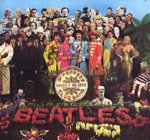
Likewise with the Beatles. When they began their real creative work, they left behind the casings of their early ego identity, pictured as four mop-top wax dummies in early Beatles suits at what appears to be a burial on the cover of the Sgt. Peppers album, while the “new” Beatles appeared above like butterflies just left the cocoon in brightly colored satins and playful epaulets.
At the building vortex of their work, John went through a classic shaman’s arc, the same as the one described by Dante in The Divine Comedy; the same ascribed to Jesus by his followers thus, “. . .he descended into hell the third day . . . . he ascended into heaven.” (As E.C. Krupp writes that Santa Claus, an archaic remnant of a Norse shaman, enters the subtle realms of the archetypal shamanic journey by descending the chimney to the Underworld and flying through the Cosmic Heavens with magical reindeer.)

This is the classic pattern of the journey of the shaman described by anthropologists and it occurred with John as the Beatles rose to the top of their creative arc. IN this kind of psychological transformation, the man or woman who is about to enter into Unconscious falls, out of nowhere and against his or her will, into a funk. He falls into a torpor, a sickness of the mind and heart and feels a worthlessness to his life. He goes through a period of spiritual death and descends deep into the earth. Afterwards, he ascends and rises into heaven. Finally he emerges transfigured and enlightened god king, leaves the celestial place and comes out, usually down from a mountain, with a simple transforming idea for the tribe, a gift from the Land of the Dead.

Lennon went through such a transformation, falling into a psychological funk and getting fat and afraid at the peak of the Beatles initial popularity (“Help,” he sang. “I’m a loser, and I’m not what I appear to be.”) Then at the Revolver album, something new began to happen. Suddenly there is a sense of entering the river, an image which occurs in dreams at times of birth or death (“turn off your mind, relax and float downstream,”) and at times of psychological transformation. In Buddhism and Taoism, it is the sign of a new awakening.
He sang a second song on the same album about floating downstream in a transcendent, blissful sleep, while everyone thinks he is just lazy, (but “I don’t mind,” he sings, “I think they’re crazy”). Some say I’m Only Sleeping is aesthetically the best song he ever composed.

In terms of anthropology, this is the first orientation of an earth shaman finding his feet in the Underworld – the creative unconscious – the world under the earth, where he will take you down with him into the density of the earth, but this is the Subtle Realm of the earth, the Underworld, where “nothing is real” in Strawberry Fields.

And there he finds clarity and confidence, but in a new world, the world of the Unconscious where there is understanding of all you see with eyes closed, and the old world becomes a shell, a mere caricature of psychic life.

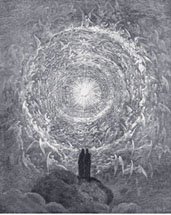
The shaman then ascends out of the earth and into the sky, like Jesus rising out of the tomb and entering heaven. John and the Beatles rise then to the very height of their work in Sgt. Peppers Lonely Hearts Club Band. And here at their best work is the shaman’s archetypal journey to the heavens in Lucy in the Sky with Diamonds. Like the Underworld of Strawberry Fields, the Astral Heavens also have otherworldly features, like newspaper taxies and magical rivers with tangerine trees and marmalade skies (like the tree “showered with reddish blossoms” blazed in light, a cosmic vision Jung had – a “vision of unearthly beauty” which oddly enough, took place in Liverpool, home of the Fab Four. Lennon’s dream vision in Lucy in the Sky with Diamonds also echo’s Dante’s, looking upon the stars from above, in Paradise: “I saw light in the shape of a river/Flashing golden between two banks/Tinted in colors of marvelous spring./Out of the stream came living sparks/Which settled on the flowers on every side/Like rubies ringed with gold . . .”).
At the peak, John wrote a song called I am the Walrus in which he invoked the Upanishads, which along with The Autobiography of a Yogi was very popular back in those days. John wrote, “I am he,” about the swimming together of all of us at the peak of the Sixties, and “we are all together.” “I am the Eggman,” he sang, with his characteristic Liverpool humor, “. . . they are the Eggmen. I am the Walrus.”

Lennon’s favorite book was Alice in Wonderland and the Abbey Road album contained a snippet of Lewis Carroll's prose. He may have drawn on Lewis Carroll’s wise Walrus, who would fit right in on Sgt. Peppers, holding forth on cabbages and kings to a horde of oysters.

It is all comic and hidden, but it reflects an awareness he had about being a man at the center of a world in transformation. The words, “I am he,” are from the core of Eastern spirituality and are well known to its practitioners. Shimon Malin’s recent book Nature Loves to Hide: Quantum Physics and Reality, a Western Perspective offers an explanation from science: He writes, “Erwin Schrödinger had the experience of finding the soul of the universe within himself, as his own ultimate identity. He expressed his finding as follows: Inconceivable as it seems to ordinary reason, you – and all other conscious beings as such – are all in all. Hence this life of yours which you are living is not merely a piece of the entire existence, but is, in a certain sense, the whole; only this whole is not so constituted that it can be surveyed in one single glance. This, as we know, is what the Brahmins express in the sacred, mystic formula which is yet really so simple and so clear: Tat twam asi, this is you [or I am he or this is that]. Or, again, in such words as ‘I am in the east and in the west, I am above and below, I am this whole world’.”
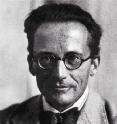
Malin writes that Wolfgang Pauli, when asked if he believed in a personal God, responded with an answer that suggests a mandala: “May I rephrase your question? I myself should prefer the following formulation: Can you, or anyone else, reach the central order of things or events, whose existence seems beyond doubt, as directly as you can reach the soul of another human being? I am using the term “soul” quite deliberately so as not to be misunderstood. If you put your question like that, I would say yes.”

This expression reflects the sentiment of the Upanishads in which the Atman (the Eggman) or the individual soul, finds itself at one with another individual soul, then another, then the whole soul, the world soul, the God consciousness, the Brahmin (the Walrus). It is what Jesus had become after he had gone through the Transfiguration, referring to himself as at one with the God force, at One with the Father. This is the Brahma consciousness.
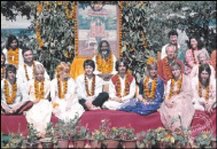
The Beatles were at their peak with Sergeant Peppers. There John would find fulfillment, anthropologically speaking. Then he would journey to the East, although Paul and Ringo were bored, and find the mystic Maharishi Mahesh Yogi, a father figure to him, but a Great Father, a spiritual father, not an earthly father.

The shaman’s work is essentially over by then, except to bring the gift idea to the community. The shaman has brought the tribe with him through the transformation of the Unconscious. It is up to us after that.

Yet some of the Beatles greatest work would come as they traveled down the back side of the mountain. The White Album is still a favorite to fans. One song, I’m So Tired, wonderfully reflects the rite of exit of the exhausted artist that comes at the end of the transformational passage, balancing the liberating I’m Only Sleeping, at the rite of entry.

It is characteristic of the dark side of the passage that the archetypes reverse themselves and show themselves not as they are in the holistic form of the inner life, but just the opposite, shattered in the outside world, reflecting that the center has been passed through and we have once again entered the flat consciousness of the everyday world. And in this instance, it was a hostile world at war in Vietnam and on the streets and campuses of the United States (“Happiness is a warm gun,” sang John)

“Can one live with a shattered glass?” the guru classically asks a Tibetan monk who has just found Enlightenment.

And here – classically - the Beatles reject their psychological god-king, the Maharishi, and even publicly denounce him. Here John sings, “My mother is of the sky.” Lucy is of the sky, his anima, his female counterpart whom he found in transcendent journey. Mother is of the earth. And the tricksters continue their playful treachery, fooling their audience and keeping them off guard with pranks like this one: “ . . . here’s another clue for you all. The Walrus was Paul.”

The Walrus, of course, was John.

Coming off the backside of the mountain – and on return form India - John sometimes believed he was carrying – channeling, we say – Jesus and said so to the Beatles. And he made occasional references, even paraphrasing the Gospel of Thomas “. . . the inside is out/the outside is in. . .” on the White Album.
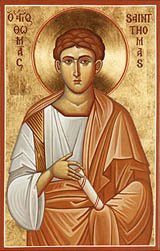
The full text is, “Jesus said to them:/When you make the two one,/and make the inside like the outside,/and the outside like the inside,/and the upper side like the under side,/and (in such a way) that you make the man/(with) the woman a single one,/in order that the man is not man and the/woman is not woman; when you make eyes in place of an eye,/and a hand in place of a hand,/and a foot in place of a foot,/an image in place of an image;/then you will go into [the kingdom].” – from The Gospel of Thomas.

This preoccupation with Jesus appears again and again. “Christ, you know it ain’t easy,” he sang in one of his last songs, suggesting in The Ballad of John and Yoko that he, like Jesus, would be crucified.

Certainly Lennon made himself look like Jesus at the end of the Beatles. On their last album cover, Abbey Road, he is dressed all in white, like Jesus after the Transfiguration, with the Beatles trailing him across the road, like the Three Celestial Ones (see this blog in January, 2006 for the Three Celestial Ones), following in his wake. (And cultism would abound in the Beatle myth. The old Catholic myth about the three secrets revealed to the children at Fatima by the Blessed Mother took a pernicious turn into hippie lore in the late 1990s when the Pope revealed the third secret to be about a “man in white” who would be gunned down when he returned from the mountain top. The Pope, who had been wounded in an attack at the same time that Lennon was murdered, revealed the contents of the letter to the public because he said the prophecy had been fulfilled. John Paul II, who wore white garments at public ceremonies, claimed to be the man identified in the prophecy.)

Even later, at the very end of his life Jesus is suggested. All through the most creative period, the shaman’s journey from Sgt. Peppers to the end of Abbey Road, John wore a special flowered talisman around his neck. Afterwards, he stopped wearing it. But in New York, in one of the later pictures ever taken of him, a well-known photograph where he is wearing a t-shirt that says New York City across the front, there is a tiny cross hanging from his neck.

At the end of the Beatles period John continued in a prophet’s journey. Like Moses and the Bodhisattva, he returns from a celestial vision on top of the mountain with a simple transforming idea, as Moses did with the tablets.

It is the same idea that has occurred throughout the century but is new to our century here in the West. It is Emerson’s message and here it is again expressed ten years before the Beatles by C.G. Jung: “Our world has shrunk, and it is dawning on us that humanity is one, with one psyche. Humanity is a not inconsiderable virtue which should prompt Christians, for the sake of charity – the greatest of all virtues – to set a good example and acknowledge that though there is only one truth it speaks in many tongues, and that if we still cannot see this it is simply due to lack of understanding. No one is so godlike that he alone knows the true word.” As Woodstock guru Satchidananda put it, “One truth, many paths.”

It is the same idea that Leo Tolstoy, a Great Father figure to the non-violence movement of the Sixties, had brought to the world after his night of the dark soul when he went through a religious transformation.
Lennon, with his wife Yoko Ono, entered the peace movement when he left the Beatles, and like Tolstoy later in life, attempted to apply his natural gifts didactically to public purpose. He is said to have been reading Tolstoy’s late non-fiction work on religion and non-violence as many were in the late 1960s, and his final word, the simple transforming idea he brought down from the mountain is precisely the same thought as Tolstoy’s: Imagine there’s no country, it isn’t hard to do. . . Imagine all the people living life in peace.

Tolstoy claimed that there was one singular thought in Christ’s work and that was do not return violence with violence. On this he built the doctrine that would inspire Ghandi and Martin Luther King, Jr. and the anti-war activists of the 1960s. Furthermore, in Patriotism and Government, Tolstoy wrote that patriotism was a practicable solution for nations early in their development, but it was time now to abandon national prejudices. Even Ghandi, who he corresponded with and who admired Tolstoy enormously, had failed in this, he said. The non-violent approach was the right approach, but, said Tolstoy, declaring the nation to be Hindu, “ruins everything.”

It was time for the removal of all barriers. No country, and no religion, too. This would be Lennon’s final impression on the people: Imagine there’s no heaven, it’s easy if you can, no hell below us, a brotherhood of man.

This is precisely Tolstoy’s religious conviction at the end of his life. He advocated abandoning identity with a particular prophet as one would abandon nationalism.

In one of his last writings on the subject Tolstoy clearly states his opinion: “Attributing a prophetic mission peculiar to certain beings such as Moses, Christ, Krishna, Buddha, Muhammad, Haha’u’llah as well as several others is one of the major causes of division and hatred between men.”

John’s swan song, Imagine, reflects timeless Buddhist sentiment like that presented in What the Buddha Taught by Walpola Rahula, which had gained popularity in the Sixties. And is likely an intentional reconstruction of Tolstoyan philosophy which was deeply influenced by Buddhism and Taoism. Intended or not, it completes the shaman’s journey and begins the transformation of the group.

Imagine also bears a relationship to The Gospel of Thomas. Elaine Pagel's book Beyond Belief: The Secret Gospel of Thomas, states that in Thomas’s account, Jesus challenges those who mistake the kingdom of God for an otherworldly place or a future event: Jesus said, “If those who lead you say to you, Look, the kingdom is in the sky,’ then the birds of the sky will get there before you . . .” In a word, Imagine there’s no heaven.

William Butler Yeats writes: “What portion in the world can the artist have/Who has awakened from the common dream/But dissipation and despair?” Such was the lot of John Lennon.

Late in life, broken and in pain, he wrote, “I was the Walrus, but now I’m John.”

One of his biographers writes that he was never happy again after the Sgt. Peppers period. The pictures show it. He never smiled again for the camera after he returned from India.

Friday, November 30, 2007

Dems need to Kick it Old School and Kick Out the Clintons

By Bernie Quigley for The Free Market News Network 11/30/07

The most important thing that has to happen in politics between now and 2012 is that the generations need to shift. Both the Democrats and the Republicans alike have to leave it all behind. Ron Paul has opened a gate for the Republicans but the Democrats are still in a quandary. For the Democrats to get a fresh start, they need to leave the Clintons behind.

The invasion of Iraq was a Republican initiative but it was fully enabled by weak Democratic leadership, benign attention and implicit support from the most important and influential Democrats, especially President Clinton and Senator Clinton, who then and now had the greatest impact on public opinion.

Today President Clinton says in the WaPost that he ". . . opposed Iraq from the beginning."

The issue is well reported on the Virginia political blog Raising Kaine. Among quotes to the contrary, these are from June 23, 2004 (CNN):

“I have repeatedly defended President Bush against the left on Iraq, even though I think he should have waited until the U.N. inspections were over.”

“That's why I supported the Iraq thing. There was a lot of stuff unaccounted for.”

It was a disappointed to read this morning in the Time magazine piece that Obama would consider including President Clinton in his cabinet. That makes two of the leading Democrats who would include President Clinton in their cabinets.

I first went to Mark Warner several years ago because I saw the new century opening up from either Mark Warner or Mitt Romney. This I gleaned from a national Governor's Council meeting several years ago, where Warner and Romney both brought forth their long-term visions. Both were sound visions of encouraging youth education and training and both were primarily management-based perspectives by two of the best managers of important states. They presented new paradigms and Warner especially promised to work "across the isle" has he had done as Governor of Virginia. They were both new voices. They both wanted to be President.

Generational dynamics demand that the paradigms shift entirely between generations. You can’t make your kids like Perry Como if they are already listening to Bob Dylan. Generational dynamics demand that the old be left behind so the new can rise. For example, today in the NYTs and in the LA Times yesterday, the great quarterback Brett Favre was referred to as "the last American hero" (LA) and Texas quarterback Tony Romo referred to as "The new Brett Favre" (NYTs). These are end-game comments - they mark the end of a generation of action of passion. They come because the New England quarterback, Tom Brady, was referred to as "God" on the cover of last months' Sports Illustrated, and because Brady, Randy Moss and Wes Welker have entirely changed the game of football. In football, an old era and an old generation is ending and a new era and a new generation has started.

Likewise, generational dynamics can be seen as the difference between Perry Como, Jimmy Durante and kind and the rise of Bob Dylan and The Beatles. Seasons pass. In fact, Dylan’s record company initially resisted playing Like a Rolling Stone because they knew it would change the season and their old list would recede. Dylan surreptitiously had it played in a famous New York disco to get it to radio stations.

Today we are directly between seasons again. Mark Warner and Jim Webb started a new season for the Democrats. It is not that the previous season was "bad" - just that new generations need to define themselves on their own terms. The problem for the Democrats today is that Elvis – and his relatives – won’t leave the building. But sending up kin or relatives to do the job – Elisabeth Dole, Hillary, George W. Bush – is always the sign that the generational season is in late November, early December.

When I was writing about Warner and Webb two years ago Markos of DKos had an important and influential piece in the WaPost declaring a division in the Democrats and mentioning Mark Warner and Howard Dean as "new Democrats" or representative of a new generation of Democrats. These divisions need to happen. In that same period he had a post on DKos asking "Won't these Clinton-era Democrats ever go away?" This is a representative voice of the new generation. The question has to be asked again today if Obama is going to bring Clinton-era Democrats into his cabinet.

The Democrats can define a completely new generation today with Warner, Webb, and others - I would include Kathleen Sebelius of Kansas and possibly John Lynch of New Hampshire who has defined his Governorship as "across-the-isle" like Mark Warner's and who has long admired Warner as Governor.

Jim Webb diametrically opposed the "Rubin Democrats" and their purpose in his rebuttal to Bush's State of the Union speech last February. This was implicit criticism of the Clinton-era Democrats. Webb was of course referring to Robert Rubin, the Clinton Secretary of Treasury, when he used the phrase "Rubin Democrats" although these might be considered "Jerry Rubin Democrats" since Sixties-radical-turned-Wall-St.-mogul Jerry Rubin first proposed this shift.

But this new direction from Webb, embraced by John Edwards as well, is not in opposition to all Democrats. It is Old School and pre-Clinton. And William Strauss and Neil Howe, who write about generational shifts in history, make the point that it is characteristic of the new generation to jump over the last to grandmother’s and grandfather’s generation.

The Clinton administration directly and intentionally opposed the older and wiser voices of their own party and followed instead the likes of Jerry Rubin who in the mid-Sixties advised his generation to go home and kill their parents and in the next decade told them that " . . . wealth creation is the real American revolution."

John Kenneth Galbraith, a venerable Nobel laureate and party icon from the Kennedy days, wrote a book in 1992, The Culture of Contentment, in direct opposition to Clinton's attachment to the rich and his economic policies which created a new class of the wealthy among people almost exclusively of his own generation. (Galbraith wrote late in life that he only briefly met Clinton and co. They basically had no use for him and he suggested that the feeling was mutual.)

They opposed George Kennan as well, possibly America’s greatest diplomat since Franklin, who opposed the expansion of NATO to Russia’s borders when Russia was considered weak and broken after the fall of the Soviets. This incursion was first proposed by Newt Gingrich in his Contract for America but was vigorously advanced by the Clinton administration. Kennan called it "a mistake of historic proportions." Today, as President Putin cancels an arms treaty with the West and promises to push military forces to that same region, the chickens are coming home to roost.

Webb and Edwards honor the Old School and the old traditions. I had hoped that Obama would as well, because that will be the path of the new generation.

In August, I interviewed the chief-of-staff of possibly the wisest and most venerable of the Old School, Sam Nunn of Georgia. He and Senator Lugar had just returned from Russia to mark the 15th anniversary of Nunn-Lugar work with Russia and the former Soviet Union to secure nuclear weapons and materials. Nunn, a retired Democratic Senator, has worked tirelessly to reduce the threat of nuclear warfare and in 2001 joined Ted Turner to found the Nuclear Threat Initiative. I was told that he is so dissatisfied with the line up of both parties on these issues that he may enter as a third party candidate in January.

What a Democrat needs to do - and now it should be Edwards if Obama is going to bring Bill Clinton into his cabinet - is to reaffirm the old traditions which Galbraith, Kennan and Nunn represented. To bring back the character of the Old School and leave the Clinton-era behind.
John Edwards: Bring Back the Old School

- DKos diary 11/30/07

The invasion of Iraq was fully enabled by the weak leadership, benign attention and implicit support of the most important and influential Democrats, especially President Clinton and Senator Clinton, who then and now had the greatest impact on public opinion among Democrats.

Today President Clinton says in the WaPost that he ". . . opposed Iraq from the beginning."

The issue is well reported on at Raising Kaine. Among quotes to the contrary, these from June 23, 2004 (CNN):

"I have repeatedly defended President Bush against the left on Iraq, even though I think he should have waited until the U.N. inspections were over."

"That's why I supported the Iraq thing. There was a lot of stuff unaccounted for."

Here in northern New Hampshire I've been working as a volunteer for Barack Obama who, like Jim Webb, the new Senator from Virginia, and Robert C. Byrd, the old one from West Virginia, opposed the invasion of Iraq from the start. But I was disappointed to read this morning in the Time magazine piece that Obama would consider including President Clinton in his cabinet. That makes two of the leading Democrats who would include President Clinton in their cabinets. Might have to go back to John Edwards and Mudcat Saunders.

I think the most important thing that has to happen between now and 2012 is that the generations need to shift. Both the Democrats and the Republicans have to leave it behind. And for the Democrats, that means leaving the Clintons behind.

I first went to Mark Warner several years ago because I saw the new century opening up from either Mark Warner or Mitt Romney. I still do. This I gleaned from the annual Governor's Council meeting in '05, I think, where Warner and Romney both brought forth their long-term visions. Both were sound visions of encouraging youth education and training and both were primarily management-based perspectives by two of the best managers of important states. They presented new paradigms and Warner especially promised to work "across the isle" has he had done as Governor of Virginia. They were both new voices. They both wanted to be President.

Generational dynamics demand that the paradigms shift entirely between generations. You can’t make your kids like Perry Como if they are already listening to Bob Dylan. Generational dynamics demand that the old be left behind so the new can rise. For example, today in the NYTs and in the LA Times yesterday, the great quarterback Brett Favre was referred to as "the last American hero" (LA) and Texas quarterback Tony Romo referred to as "The new Brett Favre" (NYTs). These are end-game comments - they mark the end of a generation of action of passion. They come because the New England quarterback, Tom Brady, was referred to as "God" on the cover of last months' Sports Illustrated, and because Brady, Randy Moss and Wes Welker have entirely changed the game of football. In football, an old era and an old generation is ending and a new era and a new generation has started.

Likewise, generational dynamics can be seen as the difference between Perry Como, Jimmy Durante and kind and the rise of Bob Dylan and The Beatles. Seasons pass. In fact, Dylan’s record company initially resisted playing Like a Rolling Stone because they knew it would change the season and their old list would recede. Dylan surreptitiously had it played in a famous New York disco to get it to radio stations.

Today we are directly between seasons again. Mark Warner and Jim Webb start a new season for the Democrats. It is not that the previous season was "bad" - just that new generations need to define themselves on their own terms. The problem for the Democrats today is that Elvis – and his relatives – won’t leave the building. But sending up kin or relative to do the job – Elisabeth Dole, Hillary, George W. Bush – is always the sign that the generational season is in late November, early December.

When I was writing about Warner and Webb two years ago Markos of DKos had an important and influential piece in the WaPost declaring a division in the Democrats and mentioning Mark Warner and Howard Dean as "new Democrats" or representative of a new generation of Democrats. These divisions need to happen. In that same period he had a post on DKos asking "Won't these Clinton-era Democrats ever go away?" This is a representative voice of the new generation. The question has to be asked again today if Obama is going to bring Clinton-era Democrats into his cabinet.

The Democrats can define a completely new generation today with Warner, Webb, and others - I would include Kathleen Sebelius of Kansas and possibly John Lynch of New Hampshire who has defined his Governorship as "across-the-isle" like Mark Warner's and who has long admired Warner as Governor.

Jim Webb diametrically opposed the "Rubin Democrats" and their purpose in his rebuttal to Bush's State of the Union speech last February. This was implicit criticism of the Clinton-era Democrats who detached Wall St. and the financial markets from the actual performance of the economy in the traditional Republican fashion. Webb was of course referring to Robert Rubin, the Clinton Secretary of Treasury, when he used the phrase "Rubin Democrats" although these might be considered "Jerry Rubin Democrats" since Sixties-radical-turned-Wall-St.-mogul Jerry Rubin first proposed this shift.

But this new direction from Webb, embraced by John Edwards as well, is not in opposition to all Democrats. It is Old School and pre-Clinton. And William Strauss and Neil Howe, who write about generational shifts in history, make the point that it is characteristic of the new generation to jump over the last to grandmother’s and grandfather’s generation.

The Clinton administration directly and intentionally opposed the older and wiser voices of their own party and followed instead the likes of Jerry Rubin who in the mid-Sixties advised his generation to go home and kill their parents and in the next decade told them that " . . . wealth creation is the real American revolution."

John Kenneth Galbraith, a venerable Nobel laureate and party icon from the Kennedy days, wrote a book in 1992, The Culture of Contentment, in direct opposition to Clinton's attachment to the rich and his economic policies which created a new class of the wealthy among people almost exclusively of his own generation. (Galbraith wrote late in life that he only briefly met Clinton and co. They basically had no use for him and he suggested that the feeling was mutual.)

They opposed George Kennan as well, possibly America’s greatest diplomat since Franklin, who opposed the expansion of NATO to Russia’s borders when Russia was considered weak and broken after the fall of the Soviets. This incursion was first proposed by Newt Gingrich in his Contract for America but was vigorously advanced by the Clinton administration. Kennan called it "a mistake of historic proportions." Today, as President Putin cancels an arms treaty with the West and promises to push military forces to that same region, the chickens are coming home to roost.

Webb and Edwards honor the Old School and the old traditions. I had hoped that Obama would as well, because that will be the path of the new generation.

In August, I interviewed the chief-of-staff of possibly the wisest and most venerable of the Old School, Sam Nunn of Georgia. He and Senator Lugar had just returned from Russia to mark the 15th anniversary of Nunn-Lugar work with Russia and the former Soviet Union to secure nuclear weapons and materials. Nunn, a retired Democratic Senator, has worked tirelessly to reduce the threat of nuclear warfare and in 2001 joined Ted Turner to found the Nuclear Threat Initiative. I was told that he is so dissatisfied with the line up of both parties on these issues that he may enter as a third party candidate in January.

What a Democrat needs to do - and now it should be Edwards if Obama is going to bring Bill Clinton into his cabinet - is to reaffirm the old traditions which Galbraith, Kennan and Nunn represented. To bring back the character of the Old School and leave the Clinton-era behind.

Monday, November 26, 2007

Comment to Mr. Cavett's column in the NYTs 11/26/07

Vintage Mailer. For all the gruff and hostile performance art, he (Norman Mailer) was remarkably kind and generous to us rustic provincials. In the late ‘70s I randomly sent him a manuscript for a novel and to my surprise he sent it to his publisher. Over the years I continued to send him things and he always responded with wry and witty comments and occasionally drawings and illustrations, including a caricature of Ronald Reagan admiring President Bush. After 9/11 I wrote to him at Provincetown and asked him to speak up. I received a drawing back of a Cyclops with giant genitals. It read: “So, I said to Aeschylus ‘You don’t understand the nature of Greek drama.’”

Monday, November 19, 2007

Ron Paul and Mitt Romney: Why is Japan Killing the Whales?

By Bernie Quigley for The Free Market News Network on 11/19/07

The 2008 Presidential race will bring an end to Clinton-era Soccer Mom politics. No longer will everyone get a trophy. No longer can just anyone and their wife, secretary or auntie be President, Senator, Supreme Court Justice or Attorney General. The price of incompetence mounts daily. Virtual disaster is at hand and there is real potential now for America to fall into third world status.

In Soccer Mom America everybody got a chance. Married six times? Outstanding bench warrants in Nashville? Sexual assault charges still lingering in limbo in Arkansas? Fail to pass the bar in D.C.? Don’t know how to file income tax yet? Hard time for trafficking in Florida? Not a problem. Everybody gets a trophy. You can even be President and with the proper stylist and consultants the fact that your only education was as a free-church preacher in the taking-up-serpents churches in the hollows of Appalachia can spin to your advantage: On that free-basing cocaine and dog fighting conviction you can play the Born Again card.

No more. Nature demands – survival demands – a return to the aptitudes and abilities of the very best among us.

Elsewhere, away from of the dreary night of politics, a sea change is being marked by astonishing gifted athletes Tom Brady, Randy Moss, Wes Welker and the New England Patriots coach Bill Belichick who brought them together. They have changed football as Bob Dylan and The Beatles changed music. And likewise they will change our world and our generations. Necessity will demand that that same level of surly New England excellence that Belichick brings to football be brought to everything we do in the world including politics and government, lest we fall into a chasm between Asia and Europe.

And say what you like about him but Mitt Romney brings the same level of management to politics and government that Belichick brings to football.

But Romney will not turn the age although he is likely to manage it: Ron Paul will turn it.

Why are the Japanese killing the whales? Because no one cares what America thinks anymore. The U.S., riding the economic curve out of World War II and on to the end of the century, established post-war values in the world and if the world wanted to play with our football they would play as we played – there was no other option but the commies. Our values; that is, the things that we thought - through vanity possibly or delusion - were the good and great things of the world; from Jefferson and Madison to Cal Kline and Michael Jackson - created the climate the others were to bask in if they hoped to play.

No more. Now they will do what they like and it starts with the Japanese.

Japan understands subtle. Bunraku puppet theater is a masterful dramatic tradition in Japan where the puppets are all surrounded by shadows in black cloaks, which adds a spooky dimension to the action – the players are puppets; they are merely pawns to the shadows and forces unseen from the unconscious. All public action is contrived and symbolic puppet work, artfully placed. Japan acted in Samurai tradition when it yielded in submission to MacArthur; the vanquished in the warrior’s honor tradition submitting its will to the master and victor. They would do what the master demanded: They must become slave and subset to the master and be the master’s will. Play baseball. Turn Christian. Whatever. Stop killing and eating beautiful, sensitive and psychic humpback whales as sushi. Today, the warrior tradition yields. Japan leaves America and MacArthur behind.

Overt symbolism was always important and apparent in relations with the Japanese. Back in the early 1980s when Japanese management strategies became a fashion I remember a discussion by a Japanese diplomat on the McNeil/Lehrer news hour about America turning to the hollow aluminum baseball bats. The diplomat was urging the Victor to show his Valor and the resolute character and resilience which conquered him and his world. He was asking us to again seek excellence, and to be all that we could be. And get rid to the aluminum baseball bat, he said, it is hollow, empty and manufactured. Go back to the wooden and shamanistic Louisville Slugger which represented America when we rose to greatness.

In Robert Christopher’s book, The Japanese Mind, which helped explain Japan to America back then, Christopher made the point that the Japanese had only a few options for success in the globalist post-war world. The one was to tag along on America’s path as America demanded. Another was to find fellowship with a rising China. Today you might add Europe and Russia as well. Such conspicuous public symbolism as beginning again to hunt the humpbacks is certainly not accidental. It is Japan’s Samurai spirit saying to America: We are free from our burden of failure and atonement. You have failed in the Master’s Task: we no longer owe you fealty.

Was bound to happen. And of course, China – still fuming about all those Southern Baptist politicians suddenly madly in love with the Dalai Lama – will try to bring the slowest of deaths now by inching toward Russia and the revolutionary peasants below the border suddenly oil rich. Time to read Sun Tzu again: “All warfare is based on deception. Hence, when able to attack, we must seem unable: when using our forces, we must seem inactive; when we are near, we must make the enemy believe we are far away; when far away, we must make him believe we are near.” Now they are dropping T Bills and dollars and trading up for euros and sterling and the world follows as if on the path of a trail of crumbs dropped in the forest. Even rap singers and supermodels are demanding pay in euros.

Ouch. The sudden friendship of the French should have been the tip off. Now the French like us. No one else does.

We are at the end of things and at the beginning of things. The tiresome thing about this Presidential campaign is that it is like watching TV reruns on the high stations; there is Frazier, Seinfeld and the Clintons; there is John McCain in his Old Soldiers uniform recalling wars of those old enough to be grandfathers and great grandfathers.

But things begin as well. I think it is fully possible now for Barack Obama to win this Presidency and I hope he does. I want to see a man whose grandfather lived in an African village become President of the United States. Paul and Obama were the only candidates to instinctively oppose the neocon fantasy in Iraq. Everyone knew it was smoke and mirrors. The politicians Clinton, Kerry and Edwards simply yielded to war fever. It was the first test of management in our century and only Obama and Paul passed.

And in the Senate, only Obama instinctively knew and understood that habeas corpus is the basis of the white man’s long journey from the 12th century to the millennium. He understands in his most primary nature that torture does not call for cutesy comments to the moderator like Hillary’s spine-chilling retort that she’d talk to her husband about his position. (As Alan Dershowitz has pointed out, Bill Clinton’s position on torture was the same as his and as Rosa Brooks pointed out in the LA Times last year, Hillary’s was – surprise – the same as her husband’s.) And like Jack Kennedy and Arnold Schwarzenegger, Obama is the only candidate with an unquenchable smile and one which shows a primary life force of joy and belonging.

If Obama does win, he will be a curing, healing President. A President who brings élan and world spirit like a Jack Kennedy or Bobby. Or like the folksy Sunday-school teacher who returned us homeward to ourselves, Jimmy Carter.

But Ron Paul brings a sea change. Never before have ideas like his held sway in America and those ideas have been around for a long time. And never before has New Hampshire seen such a scene with a politician.

The Concord Monitor, in describing the aftermath of a September campaign rally in Manchester, wrote: “Members of the audience chanted his name. Several jumped up and down. Descending from the stage, [Paul] found himself surrounded by supporters snapping cell-phone photographs. Two women turned so Paul could sign the backs of their T-shirts.”

The decline of the dollar and the descent of the American economy into a valley between Asia and Europe brings the end of America’s globalist economic arc in the world. Bush killed it, possibly intentionally. Perhaps he is a closet Libertarian and prefers the city-state or nation-state to world government and globalization based out of Wall St. I’m about 70% thinking he does.

But when things end they don’t die. They turn into something else. And Paul’s popularity is rising because his ideas on economy and culture are suited to the times and suited to the times ahead.

Paul might be what anthropologists call a Monkey King; he is the creator of a new era and inspires new leaders and new paths of leadership. The generation or generations which follow look first to Monkey King. History often forgets their names, like firebrand James Otis who inspired John Adams to revolution or Theodore Parker, the fiery Massachusetts preacher and Yankee crusader who egged Lincoln on to warfare. The leaders who come now in the fourth post-war generation will look to Paul.

And given time, I believe Mitt Romney and the best minds in the Republican Party will look to Ron Paul because the Republican Party has split now between the Paul faction and everybody else. Paul is a natural for the South and Southwest and vocalizes much they have long felt. Paulites and Paulines will rise and advance in red America and in states where small government and states rights are taking new meaning. This is a new historical path and one more suited for the U.S. in the century ahead. It is suited to an America fully formed with rich and indigenous regions which increasingly over the decades will have a less and less need for a federal government, and as California and the Eastern States have directly expressed recently, find the Hamilton tradition of federalism to be an impediment to their progress and prosperity. It is an impediment to excellence.

There is a widely held misunderstanding about Romney – one reflected in a poor article this week in the Washington Post. It is that Romney, because he is a Mormon, will not accept new ideas. I wonder if these people actually watched the 2002 Winter Olympics which Romney took over as President and CEO and rescued it from incompetent leadership. The entertainment was largely run – it seemed to have been commandeered – by Robbie Robertson, a Monkey God of my own generation, who brought the world Woodstock, The Band and Bob Dylan in various guises. Robertson brought in a whole bunch of Canadian First People; women primarily, and had them waving herbs and shouting Indian blessings at the athletes. He brought in great singers and entertainers like Rita Coolidge from the Sixties period. Indeed, it was all a great hippie show leading up to an “Oklahoma” style dramatic presentation on the celestial rise of the White Buffalo, a Native American Indian harbinger of the rising Age of Aquarius.

To the contrary; there may indeed be a positive management aspect of being a Mormon. Here in Massachusetts Romney felt no inherent conflict between Irish Catholic and White Glove Unitarian; a Curse greater than the New York Yankees which had fated the region since Emerson and Parker.

Paul and Romney are fully at odds over Iraq and many other things. But what Romney can do like no other is take a fresh idea and form it, fill it in and contour it to suit the day. We are seeing now in Ron Paul ideas which may not have worked 30 or 50 years ago. But they may be perfectly suited to the times ahead.

Romney’s staff has stated that it is still looking for the single idea as keystone to the Romney campaign and a Romney Presidency. Possibly he will find it in Ron Paul.

The idea of small government in particular, has never been fully formed. Ron Paul speaks to it as did Reagan. As the coffers shrink in big states like California and throughout the U.S., smaller government will become a necessity. But since Reagan, “small government” has meant only thin government. If governments are to lose their wealth and weight, the shape and packaging of government must change.

Government is almost exclusively about packaging. But like the puppets in Bunraku theater, ideas about government are surrounded by spooks and dark shadows - and regionalism conjures ghosts from 1865. However, a regional council for the Katrina region for example, would at least temporarily manage the multifaceted issues of repair, environment and law enforcement that need to be handled together. Only Romney has recognized that “one size fits all” federalism brings widespread incompetence to problems of poverty and prosperity. This begins to travel the path of Paul.

Up here in New Hampshire, the Free State Project people, who I admire and respect, have a simple plan. As one mountain independent put it on her blog, their issues are uncomplicated: “legalize marijuana, end the war, Hillary is a commie . . .” They would have no problem with George Kennan’s desire expressed in his last days, of seeing America divided into 12 working regions. People expect us to behave like that up here; if they tried it in other states the Homies (that would be the Homeland Security) would be on their tails.

But regionalization, seen without spooks and shadows, in no way challenges the entity and essence of the United States, it simply shifts the responsibilities for solving problems to states and regions. It is simply a way of building matrixes for small government; of defunding federalism and repackaging appropriately to the various cultures on the continent without causing chaos and difficulty. It is simply a better package in a continent fully culturized; a matrix for community tier economy and a Jeffersonian vision of family, community and culture.

In truth, community cannot hold in Hamilton’s view in which corporation is primary and its main cell of energy is the individual. In Jefferson’s view it is family, church, region and community tier economy. It is a difference of Particle and Wave, and as we learned from the physicist/shamans of the 1920s and 30s, one can be either a Particle or a Wave, but not both at the same time: In a word, Hamilton and Jefferson are incompatible, but they can alternate, and the one best for some conditions is worse for others. The Jefferson path – the Paulist path – could well be the better package for our rapidly arriving century.

The days of the Soccer Mom are quickly fading. Necessity returns us to excellence as it returns us to our truest nature in the darkest hour. I first spotted the first slouching return to competence and excellence on the TV show House; it is an auspicious harbinger of the age ascending. Dr. House is a genius intuitive with skill derived from his own knowledge, perseverance and experience. He is Master in a sea of self-assured, incompetent, group-think professionals born of management theory and Best Practices conferences. He is universally despised by Organization Man and even crankier than Bill Belichick. He is a cripple, a freak and an outcast in an autonomous and self-sustaining management culture in which everyone is used to getting a trophy.

Thursday, November 08, 2007

“Chicks up front”: Why Hillary Will Support the Draft

By Bernie Quigley for The Free Market News Network, 11/09/07

I take Mitt Romney on face value when he says the all-volunteer army is working and he doesn’t intend to change it. It is in keeping with his nature and all his personal history to manage and improve an existing paradigm rather than to arbitrarily break it and do something else. But what will President Hillary do? I am almost certain by now that she will establish a military draft.

I have traveled in the same river as these people and one of the weirdly random talents I have had in my life is to show up unintentionally at places just when they were getting interesting. Like when Jack Kennedy rose out of my father’s old neighborhood in Boston and ran for President when I was a kid. And when Bob Dylan awakened the Sixties kind of in my high school football field in Newport R.I. Another was in August, 1968. I had just completed a year’s tour of duty in Thailand and began a half world journey; down the mountains and through the jungle by slow train to Bangkok and after a stay for a week or so at five-baht peasant hotels, the flight back to San Francisco. I had just enough travel money left to make it to Chicago.

I ended up sleeping in Union Station for three days, waiting for family to wire some of my cash. I hadn’t a clue what was going on in the U.S. When I arrived in Chicago the city was in turmoil. It was during the riots in the 1968 Democratic Convention.

As it turned out, it was a major turning point for people my age and thousands gathered to protest the war in Vietnam at Lincoln Park and Grant Park. Signs in the crowd read, “Chicks up front,” so the coppers wouldn’t hit so hard, said to have been orchestrated by Yippie leader Abbie Hoffman, the main organizer of the event.

It was certainly a time for change for Senator Clinton as well. As reported in a recent NYTs article on the turmoil of '68: "As the nation boiled over Vietnam, civil rights and the slayings of two charismatic leaders, Ms. Rodham was completing a sweeping intellectual, political and stylistic shift. She came to Wellesley as an 18-year-old Republican, a copy of Barry Goldwater’s right-wing treatise, The Conscience of a Conservative, on the shelf of her freshman dorm room. She would leave as an antiwar Democrat whose public rebuke of a Republican senator in a graduation speech won her notice in Life magazine as a voice for her generation."

Chicago brought forth a potential American passage; the trial of the Chicago Seven featuring Hoffman, Jerry Rubin, Dave Dillinger and others followed as denouement. It might have amounted to a change in the way we live in this country: Recently I’ve been sent into a kind of déjà vu as I have heard some of the exact same anti-war phrases by those who opposed the invasion of Iraq and have used some of them myself.

But it didn’t turn out because the hippies and the war resisters did not pass the test of fire: On May 4, 1970, when four were left dead at Kent State the party ended. Rubin said in one of his autobiographies that after Kent State you couldn’t get girls to type your term papers for you anymore. You couldn’t call them chicks anymore either. Earth Mother had yielded to Wall St. and the corporate culture.

That failure haunts that same generation today because a revolutionary culture cannot change in mid-stream and join the mainstream corporate culture; Kent State could have triggered a mass uprising like the Irish Rebellion or the Boxer Rebellion in the last days of Manchu rule. A new culture – a new auspicious world – could have arisen from Kent State. But it failed. As such, it cannot well be incorporated in the experience of the individual as a psychological or mythic transition to adulthood. It can only be considered a few years of escapism and play: You cannot really be against the war and be for the soldiers as it is the fashion to say today. You have to be on one side or the other.

That was John Kerry’s problem from the first. He wanted to be one of the hippies . . . and was famously photographed at an anti-war rally with John Lennon . . . and one of the soldiers too; he proudly decorated his office with his military colors. It doesn’t work. The hippies didn’t consider him one of them, nor did some of his fellow soldiers who swift-boated him.

Gary Hart made a better transition. He opposed the war in Vietnam and directed George McGovern’s anti-war candidacy. After the war he became a military officer and a military expert. At all times, including today, he knew who he was. As the invasion of Iraq loomed some of us invited him to come speak here in New England on the topic. His opinion and his prediction of vast and extended warfare across the Middle East was perfectly accurate. Senator Clinton, who should be considered the leading voice of the Democrats at that time, did not listen to him. She listened instead to the focus groups and to the hordes when war fever and revenge were sweeping the country.

Senator Clinton today represents the people of her age who opted-out of the hippie days when its brief allure receded in the smoke at Kent State. They followed the path instead to Wall St. with Jerry Rubin and Arkansas po' white Bill was avatar to this transition. Rubin called himself a “pilot fish” to his generation and he is key to the age. Rubin had told them in the Sixties to go home and kill their parents and to avoid investment because, “A hip capitalist is a pig capitalist . . . They are traitors to their long hair." A decade later he would tell them, “Wealth creation is the real American revolution.” And the generational horde followed, like fish.

A problem arises now and has over the years and it is a mythic problem. The Billarys and the Cheneys and Bushs did not participate in the tribal adventure they were sent to as young ‘uns and they all appear to be living out the failed consequences of a myth unfulfilled. Certainly Cheney and the neocons seem to be living out a dangerous fantasy with their war adventures in Iraq and everywhere, but likewise the Dems seem to be unleavened by the tragedies and successes of military experience.

The key question today is how will the Democrats and the Republicans manage the continuing mess in Iraq, Pakistan and throughout the Islamic world? Specifically, will they continue to rely on the professional army which seems heavily indebted to mercenary forces like Blackwater? Or will they establish a draft?

There are two “prisons” here – as Toynbee called them. The one is mythical: She opposed the war in Vietnam which was a primary directive of Kennedy and the country at the time. To do so is in fact a very radical step; in the past, only a very small minority of Quakers or Buddhists here in New England would take it. And they would not change their views on warfare and capital once the inconvenient war was over as Hillary and the Rubin horde has. Hillary has to prove she has manlies to be President. Katty Kay of BBC has offered commentary in that regard; because she is a woman, said Kay. But more so, I would say, because she opposed the war in Vietnam. Having adopted the mainstream direction after the war, the previous position can only be considered a weakness or failure which creates compensation and dangerous instability in later leadership.

The Democrats in this regard are now displaying romanticized notions of the citizen-soldier in World War II and the draftee in Vietnam which I see as a default of intelligent analysis and avoidance of the problem at hand. This romanticizing comes from a lack of personal experience in time of crisis: One can only imagine fair action and judgment in war if there is no personal experience as touchstone, so one makes decisions by feelings and imaginings.

The question of military service popped up here in New Hampshire when Hillary came to talk recently to a group of local editors and reporters. She said to them that she sees no support among the military for a return to the draft.

Unfortunately, that does not answer the question of whether or not she supports the draft, and like oh-so-much she and her husband have said to us over the years; it does not even address the question. We already know that there is no interest in the draft in the military. And if we were unsure we would go and ask them. We want to know what she thinks about the draft and specifically, if she would establish a draft to continue the conflict which, if she, Romney or most of the others are elected, is certain to go on for at least a decade if not much longer.

But she has not answered that question.

Under the circumstance it is probably better to try to get the answer as Greg House, MD, of the clever TV show House does. House never listens to his patients. He assumes they always lie, obfuscate or hide the truth. Instead, he sends his interns out to search their houses and talk to their friends and relatives to find out what is going on.

We might do the same with Bill and Hillary. If we don’t know what they are thinking; if they are congenitally incapable of talking straight, we might look to their friends and those who they would bring with them to the Oval Office if they are elected. It has been suggested in the press that Hillary would bring either Jim Webb, warrior, novelist and the new Senator from Virginia, or General Wesley Clark. I would think that someone like Kathleen Sebelius, Governor of Kansas, or Mark Warner, former Governor of Virginia and current candidate for the Senate, would be much better but again, this is compensation – to prove that the Democrats have manlies; to prove it to themselves.

When he ran for Senate Webb was forced to answer if he would support the Democratic candidate “no matter who it is” (meaning Hillary) and he said he would. Clark was among the first to endorse Hillary this Fall and it was felt by some at the time that he had been running for VP with Hillary all along.

In ’04 when he ran for President there was a clear suggestion that he would like the job of Secretary of State. Some of the best commentators have speculated this year that because of the good work he did in the ’06 race for vets running for office and because of the high profile he showed in opposition to a potential invasion of Iran, he is certain to have an important position in any Democratic cabinet, possibly Secretary of State.

When he endorsed Senator Clinton, General Clark said he had known her for 21 years. He is one of Bill’s best friends; I see him as Bill’s “alter ego” – Arkansas guy and fellow Rhodes Scholar.

On July 6, 2004, Clark addressed a small group in Manchester, NH, and said, “I know you all don’t support the draft, but when I heard in the early 1970s that they were thinking of going to an all-volunteer army, I thought, ‘good for the army, bad for the country.’”

He cited the classic argument of a “professional army” as the tool of an elite regime while the draft was the way of an egalitarian, democratic people.

Myself, I find this faulty. Both Hitler and Stalin relied on a draft.

It is an important issue because increasingly, Clark appears to be forming opinion for the Democrats and for the Clintons.

Senator Clinton needs to be asked directly if she is committed to the all-volunteer army as Romney is or if she is in agreement with Wesley Clark on this issue. Which of these will be the law of the land when she is President?

If she doesn’t answer straight, which she won’t, we should press her on who she will bring forth on military issues and make our own assumptions from that.

She certainly believes in registration and told my local reporters that 18-year-old women, along with men should be required to register.

“I think that should be required of everyone in case of a national emergency,” she said. And in a hair-raising aside, she suggested that 9-11 was such an emergency.

“I really believe that Bush could have gotten the nation involved. He chose not to,” she said. “He had a chance after 9-11 to summon America to service and sacrifice, and he didn’t do it.”

She said she would also “like to do more” with national service and presumably everyone could be pressed into “national service” in case of “a national emergency.”

So in a Hillary Presidency, you won’t only have the chance to be pulled out of a card game, as I was, and drafted into the war in Vietnam, but could also be drafted, man or woman, into alternative service; possibly doing laundry at the White House or scrubbing floors at the William J. Clinton Library and Museum in Arkansas.

Some of my madcap, dynamic friends up here in the Free State Project in New Hampshire claim that Hillary is a commie and her yearnings go back to the early days of Trotsky or Lenin in Russia.

Her political vision goes back further than that. It goes back to Peter the Great.

Tuesday, November 06, 2007

Sarko the Appeaser: France’s New Vichy Regime

- for The Free Market News Network, 11/06/07

As the Congress of Appeasers, Accommodators and Enablers readies to hear France’s new leader, they might prep with a showing of Casablanca. At no time have the Peeps more resembled the vacillating and ineffectual crowd at Rick’s Cafe Americain. Today Charles Schulmer, the Senator for New York, takes out an op-ed in the NYT’s to claim his credibility on voting for Michael B. Mukasey for attorney general, who doesn’t think that half drowning a woman or man with a bag over her head constitutes torture. That is he isn’t sure. Schulmer follows in the footsteps of his Weak Sister from California, Diane Feinstein, who this week also cast her vote for torture with resolute conviction.

Say what you like about France, where I spent some of the best moments of my ‘tweens; it generally knows the difference between love and rape. But that cannot be said about Nicolas Sarkozy, the recently elected President of France.

Truth is, when Sarkozy visited us first off here in New Hampshire after his election we were only vaguely amused. I mean, I’ve been to Paris and I’ve been to Lake Winnipesaukee. If he felt that our live-free-or-die motto suggested that we would follow the horde to Bush’s war against the dark-skinned non-Christians of the world, he completely missed the point. And how ridiculous could it be to run for President of France pretending to emulate those of us in the northern mountains of New Hampshire? Or wearing a NYPD t-shirt?

That his wife slipped back to France under cover of night was the tip off that beneath the veneer of Austrian-Hungary Empire stuff (Sarko’s paternal line . . . startling that the French would even think of going there at all . . . ) France still had instincts.

As it is widely reported, “Sarko the American” as he is known in France, makes his first official visit to Washington today to try to “ . . . heal the wounds over France's opposition to the Iraq war . . . ” He hopes to affirm that he is a sure ally of President Bush in his most trying hour.

Good to have a friend, even one who fauns. Will Bush laugh at him when he speaks French as he did in New Hampshire? Reports tell us that there is a “collective swoon” in the Oval Office over this Frenchman. That should be a tip off: This President, like most Texans, hates France and everything about France and always did. Why do they like this Frenchman?

It seems so long ago now but as I recall, it was Donald Rumsfeld that called Bush’s New World Order, “old Europe” and “new Europe.” New Europe consisted of our vassal state England, our two pseudo-American states Poland (created by recent American immigrants in New York and Maryland) and the Czech Republic (created by American lost-in-the-ozone poet numbsculls in the English Department), Turkey and someplace else about the size of Ellis Island with a name I can’t pronounce. I got the willies at the time because at the beginning Bush’s plan – the pre-emptive policy – seemed coined originally by Wilhelm II and the only main allies at the time were England and Italy. Then when Rumsfeld got on the Jim Lehrer show to talk about how Hitler nationalized the German economy, his arms started waving and he got really animated, much like General ‘Buck” Turginson (that would be George C. Scott) in Dr. Strangelove.

Today, Poland, governed by twins - which is a nice touch for a country that can’t remember who it is - is opting out as it realizes that the price of being a pseudo-American Euro-state is high, and that these “new Europe” satellites are merely Gurka forces – Foreign Devils fighting on our behalf – in our global war on Islam and missile sites to territorialize Russia.

Now England is entirely screwed; it is neither Euro nor American and will now be continually cursed by its direct neighbors because it cast its lot with Bush. Turkey is now among our greatest enemies. And General What’s-His-Name in Pakistan, hoping to develop a new nazi-burgher class globally, is about to lose his funny CIA money.

But, alors, now here in the darkest hour, France comes to our aid.

Congress should turn this man out: He comes to us as Marshall Petain came to France. As you recall, when the messenger from the French Underground was shot down at the beginning of Casablanca, he fell beneath a large portrait of Marshall Petain, who accommodated the German invaders in the Vichy regime. Likewise Sarkozy accommodates and appeases today a President without moral bearings and a Congress without a backbone.

We are now at a Vichy moment; a moment like that portrayed in the movie Casablanca, about an incident at Rick’s Café American which turned the world from accommodation to character. Today we are all Monsieur Rick, tormented and torn between man and mouse, waiting for the man of courage and valor and resolute conviction to arrive and order the playing of La Marseillaise.

That man is not Nicolas Sarkozy.

Note to Congress: If you Google YouTube – Casablanca – French National Anthem you can view Paul Heinreid, taking his cue from Humphrey Bogart, and ordering the local band at Rick’s to play La Marseillaise, and drowning out the Vichy Swine in the greatest two minutes in the history of electricity.

Suggested reading for Sarko the American and the new torture buffs in Congress and in the Oval Office: Kranz Kafka: In the Penal Colony, Alexander Solzhenitsyn: One Day in the Life of Ivan Denisovich and much more, Arthur Koestler’s Darkness at Noon, Andre Malraux’s: Man’s Fate, Man’s Hope, Anti-Memoirs.

One question: Who raised you?
Romney's Logo & the New England Patriots
- letter to the NYTs, 11/06/07

Here in northern New Hampshire I think we couldn't care less if a candidate is Mormon, Tree Druid or a Zoroastrian Fire Worshiper. The old school worships with the Red Sox and the new school with the New England Patriots. I’m sure I was not the only one dismayed in the last few weeks when the Romney signs started going up to see that Romney's logo is almost identical to that of the New England Patriots. New England has become a different place in the last seven years and frankly, we have become a better people . . . but not because of Romney. That credit goes to Manny and Big Papi and also to Randy Moss, Wes Welker, Bill Belichick and Tom Brady. For Romney to attempt to accommodate this energy may be a few degrees away from copyright infringement but it well constitutes a crime against humanity here in New England.

Thursday, November 01, 2007

Shiva Turning: New England Nation

by Bernie Quigley for The Free Market News Network, 11/2/07


The Hillary camp's Cajun Cartel surreptitiously proselytizes the draft in WW II "common man" nostalgia (they are 15 years too late) while the Repubs will stay more likely to the current system: For the Dems it is a two-track approach, one travels the land with sentimental stories of heroism by common draftees and parables of great wars, while the central character lies outright. In any case, America has lost its identity to the incipient monarchist incursion of personality cult - Bush, Clinton - and federalism has reached the end of its decent interval.

" . . . 50 more years of war," says General Abizaid. Would be better if they taught the pseudo-monarchs and Generals they send to Oxford as Rhodes scholars something more advanced than sociology and Carroll Quigley: They become, as Toynbee said, imprisoned by their learning rather than awakened by it. Did any of these aparatchiks ever read Kipling? Koestler? Doris Lessing? Malraux?

Indeed, did they read George Kennan, America's greatest ambassador since Franklin, and who, according to a distinguished Vermont professor who spoke to him on his death bed, later in life proposed decentralizing the U.S. into a “dozen constituent republics” including New England, the Middle Atlantic states, the Middle West, the Northwest, the Southwest (including Hawaii), Texas, the Old South, Florida, Alaska, New York City, Chicago, and Los Angeles: “To these entities I would accord a larger part of the present federal powers than one might suspect—large enough, in fact, to make most people gasp"?

The West doesn't plan for 50 years. It cannot plan for five years. It is the nature of Hamiltonian federalism; it is from beginning of the rise of northern imperialism in the 1830s (which forced Canada to confederation) to advancing foreign adventures in the 1880s, to the rise to American globalism after WW II entirely a product of rising capital; an angel which has now passed elsewhere. Today capital has reached equilibrium - Wall St. is only one of many brokers and no longer the most important. New York had only three things: Wall St., the Yankees, and The New York Times. Now it has no purpose.

But as New York declines, New England ascends. The Curse was always the shadow of dominance by New York which embittered and incapacitated New England; not since Babe Ruth but since the Civil War. It has been said that the South found its identity in the Civil War. But New England lost hers. Today it awakens, and at the center of Boston there is suddenly a little zen temple named Dice-K.

We have been experiencing an end game since Reagan's passing and the Reagan Presidency itself was a last stand. The monarchist tendency, the Congress of Peeps, the incompetence of fed administrators, the preemptive policy, the failure of the dollar and the view of America abroad as pariah are organic consequences in the natural path of failure.

But things don't ever end; they change. They transform from one thing to the next; they waste their skin. The only defense against waterboarding is New England nationalism. Can we not begin to sell our own New England treasury bonds? Can we send our own representative to the UN?